
Most people treat intimacy as something that either happens or it doesn’t. A moment of connection, a feeling that arrives uninvited, an experience you hope to stumble into rather than something you consciously build. That framing, while common, is also why so many relationships plateau. It mistakes a destination for an architecture.
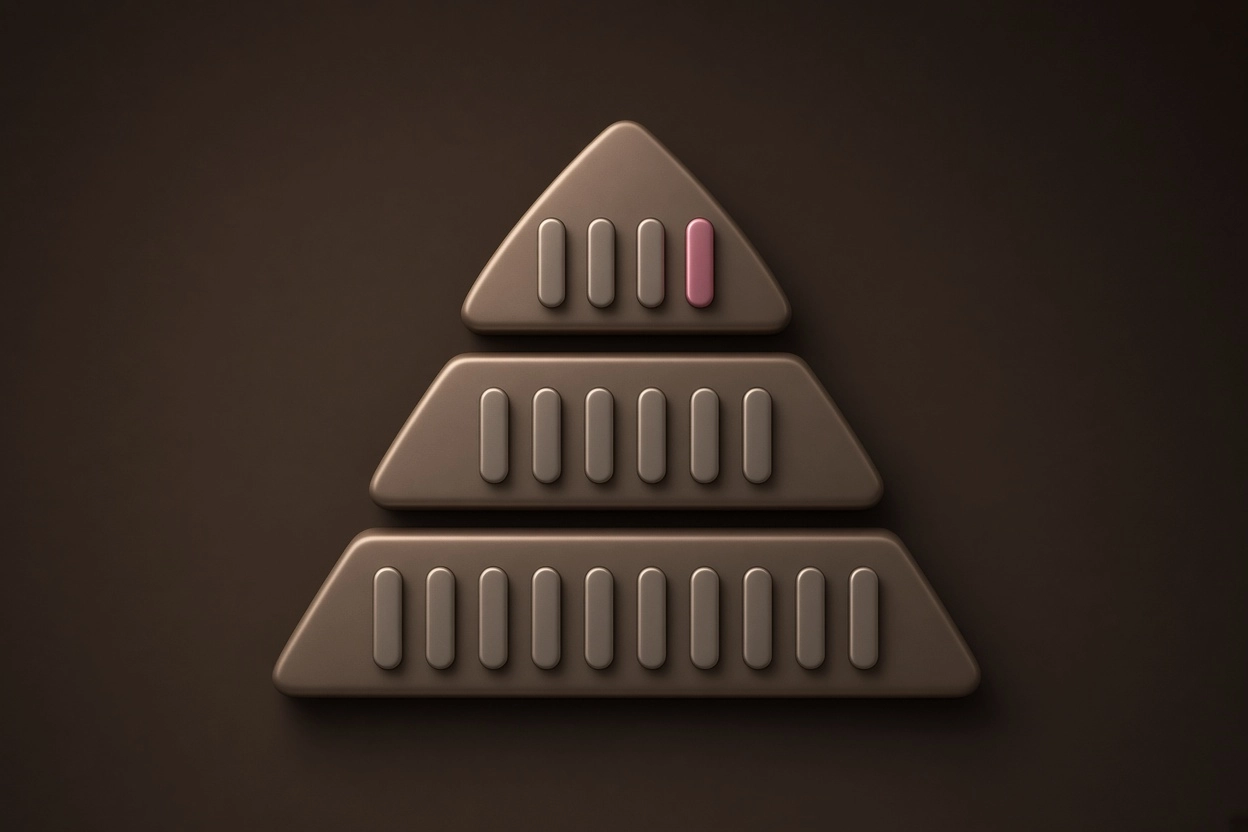
The intimacy pyramid offers a more honest model. It maps connection as a layered structure with emotional safety at the base, sensory attunement in the middle, and physical closeness at the apex. Each tier depends on the one beneath it. Skip a layer, and the whole structure becomes unstable, no matter how much effort you invest at the top.
This piece works through each tier methodically. You will learn what separates the foundation from the apex, why sensory attunement is the layer most couples bypass entirely, and how physical wellness practices become significantly more effective when they rest on what comes before them. Most importantly, you will finish with a clearer, more honest read on where you and your partner currently stand within that stack, because that self-location is where any intentional practice has to begin.
Intimacy Is Architecture, Not an Event
Intimacy is not an event. It is a structure. And like any structure, what holds it up matters more than what sits on top.
Secure bonds develop through cumulative relational experience, not spontaneous connection. Research positions intimacy as genuinely multi-dimensional, with emotional, physical, and relational layers developing in relation to one another. You cannot isolate one tier and call it the whole.
The intimacy pyramid gives this structure a name: emotional safety at the foundation, sensory attunement in the middle, physical closeness at the apex.
That dependency is not a metaphor to be appreciated and set aside; it is the operational logic of how closeness actually works. Foundations must bear weight before upper tiers can stand.
This matters for anyone who has ever reached for physical connection and found it strangely hollow, or invested in sensory experience and felt it land without warmth. The reason is almost always structural. As explored in what emotional intimacy actually means and why it comes first, physical wellness is most powerful when it rests on emotional and sensory foundations, not beside them.
What follows is a reflective mapping exercise. The goal is honest self-location, not optimisation. There is no checklist here, only a framework for understanding where you currently are and what that tells you about where to go next.
What Is the Intimacy Pyramid?
The pyramid’s three tiers, emotional safety, sensory attunement, physical closeness, are sequential, not interchangeable. The pyramid presented here draws on attachment research and therapeutic frameworks as an applied model for self-reflection, not a formally validated clinical instrument.
This sequencing matters because intimacy is routinely conflated with sex, romance, or physical affection alone. In reality, intimacy exists across all relationship types; it appears in a long friendship conducted through shared vulnerability, in a family bond held together by consistent emotional presence, in a working relationship built on mutual intellectual trust. The form changes; the underlying architecture does not. Romantic intimacy simply asks all three tiers to carry more weight simultaneously.
The framework also reframes a persistent cultural assumption: that intimacy arrives spontaneously, or not at all. Conscious intimacy is a deliberate practice rather than a climate that either exists or doesn’t. This shift is visible in the growing demand for guided frameworks, structured conversations, and intentional rituals.
One clarification is worth holding from the start: the pyramid is not a hierarchy of value. Emotional safety is not more important than physical closeness in any absolute sense. It is simply earlier in sequence. That distinction, sequence versus value, is the insight the model offers. Knowing where you are on the stack is a more honest starting point than any technique, tool, or intention applied without it.
Tier One: Emotional Safety, The Load-Bearing Floor
Emotional safety is where the pyramid earns its weight. It is the condition in which both partners can be vulnerable without fear of judgment, rejection, or ridicule. Without it, every tier above is built on an unstable surface.
Vulnerability is not a personality trait; it is a relational act. Revealing an authentic self, including the uncertain, the unresolved, and the uncomfortable, is only possible when the environment feels genuinely secure enough to hold it. Attachment research consistently shows that secure relational bonds are not incidental to how we experience everything else; they change the experience itself.
What “safe enough” actually looks like is less dramatic than most people expect. It is a partner who responds consistently rather than unpredictably. It is the ability to name a difficult feeling without first calculating how that disclosure will land. Perhaps most tellingly, it is the absence of contempt during conflict, the moment when a partner’s expression curdles from disagreement into disdain is a reliable signal that the emotional floor is thinning.
A pattern worth recognising: many couples seek physical closeness as a repair mechanism when emotional safety is underdeveloped. The closeness that follows can feel hollow even when everything is technically present. That hollowness is diagnostic. Physical proximity without the relational foundation beneath it is contact, not connection.
Two questions locate you in this tier more honestly than any framework can. Do you feel genuinely heard in this relationship, not agreed with, but actually heard? Can you share something uncomfortable without rehearsing how it will land? These are not small questions. They are the floor.
This matters for queer relationships and relationships of every configuration, because emotional safety takes distinct shapes depending on the relational context. The principle is universal; the practice is personal.
Conscious intimacy and intentional love both begin here. No technique, exercise, or tool substitutes for this layer being structurally sound. The pyramid cannot be built from the top down.
Tier Two: Sensory Attunement, The Layer Most Couples Skip

Emotional safety is the floor. Sensory attunement is where most couples lose the thread.
This middle tier is the practice of deliberately noticing and responding to sensory experience together: the weight of a hand, the warmth of proximity, a familiar scent, the texture of skin. Not as prelude or performance, but as a form of relational presence in itself. Sensory attunement is attention made physical.
It is also the tier most commonly bypassed. After an honest conversation, many couples move directly toward physical closeness, treating the emotional and the physical as adjacent rooms with no hallway between them. The sensory layer is that hallway. Skipping it is why physical closeness can follow genuine emotional openness and still feel like something is missing.
Presence lives here. Slowing down enough to notice what your body is experiencing, and staying genuinely curious about your partner’s sensory world, is itself a relational act. It does not require a destination.
Couples intimacy exercises that build this capacity tend to be disarmingly simple: sitting together in shared stillness, practicing intentional touch without any outcome attached, or using scent and texture as anchors that draw attention into the present moment rather than toward what comes next. The practice is noticing, not achieving.
This is also where intentional wellness tools enter the picture honestly. Massage, aromatherapy, and textured touch are not shortcuts to the apex; used with curiosity rather than agenda, they function as attunement aids, invitations to slow down and attend. Their value lies in what they make possible, not what they produce.
In a 2019 imaging study of 30 women in committed relationships, a partner’s touch reduced the brain’s “neurologic pain signature”, with larger effects among women who reported greater closeness to their partner. Sensory experience is not purely physical; it is shaped, at a neurobiological level, by the relational context surrounding it.
Tier Three: Physical Closeness, The Apex, Not the Whole
When sensory attunement is present, physical closeness becomes possible in its fullest sense. Without it, what passes for closeness is often something quieter and lonelier: proximity.
Physical closeness sits at the apex of the pyramid. It is the most visible tier, the one most commonly equated with intimacy itself. That conflation is the central misunderstanding this essay is built against.
The neuroscience points the same way, though it is early research. In a study published in the Proceedings of the National Academy of Sciences, romantic partners who held hands while one of them was in pain showed more synchronized brain activity, and stronger synchrony went with greater pain relief. The lower tiers are not merely context for the upper one; they are physiologically present within it. Emotional safety and sensory attunement change what the body actually experiences.
This is what structural instability looks like in practice: two people physically present, physically close, yet each quietly unreachable by the other. The architecture has not failed dramatically. It has simply never been built from the ground up. That absence is most legible at the apex, where trust finally shows its presence or its lack.
The distinction worth making is not between types of physical contact but between contact as reflex and closeness as arrival. One is what the body does by default; the other is what becomes available when the lower tiers are sound. Technique is irrelevant here. Foundation is everything.
When emotional safety and sensory attunement are genuinely developed, the apex tier rewards them. Physical closeness becomes more resonant, more sustaining, and more legible as care rather than habit.
This is also where most couples begin when they sense something is missing. They seek solutions at the apex, which is understandable but rarely sufficient. Disconnection rarely lives where it is first noticed.
Where Are You on the Stack? An Honest Self-Location
The pyramid is most useful not as a theory to admire but as a mirror to look into honestly.
Three questions, one per tier, offer a starting point:
Emotional safety: When did you last share something that made you feel genuinely exposed? How did your partner receive it?
Sensory attunement: When did you last notice something sensory about your partner, a texture, a scent, a quality of their touch, with real attention rather than reflex?
Physical closeness: Does physical connection currently feel like arrival, or like avoidance dressed as contact?
Sit with those before comparing answers. Most couples, when they do, discover they are not uniformly developed across all three tiers. One partner may hold emotional safety with ease while sensory presence has gone quiet. Another couple may be physically close in habit but thin on the vulnerability that gives that closeness weight. This unevenness is not a failure. It is simply where most relationships live at any given point in time, and naming it accurately is more productive than pretending otherwise.
Relational assessment tools and couples coaching frameworks are built on a shared premise: honest self-mapping precedes any productive practice. You cannot intentionally tend a foundation you have not yet located.
One note on how to use these questions. Treat them as a conversation to have together, not a private audit to complete separately. Discussing where you each feel strongest and where the structure feels thinner is itself an act of emotional safety. The willingness to say I think we are thin here to someone you love is already a practice, not just a prelude to one.
The goal here is orientation. These questions are a compass reading, not a diagnosis.
Intentional Love Begins With the Foundation
Once you have a clearer sense of where you currently stand on the stack, the next question is less “what should we add?” and more “what deserves tending?”
That distinction is the essay’s whole argument, restated plainly: returning, with attention, to whatever tier is asking for care is where intentional intimacy is actually built.
Physical wellness tools and sensory practices have a genuine role in that work. But their role is one of accompaniment, not replacement. A beautifully chosen object can deepen sensory attunement when it arrives inside a structure already being built. The same object cannot construct the structure on its behalf.
One thing to carry into this week, by tier:
- Emotional safety: Name one thing you have been carrying alone and share it, without softening it for easier reception.
- Sensory attunement: Choose one sensory practice with no outcome attached; notice a texture, a warmth, a quality of presence, and let that noticing be enough.
- Physical closeness: Approach one moment of physical connection this week as arrival rather than habit. Let it be a conscious choice, not a reflex.
Intimacy is not something that happens to you. It is something you build, tend, and return to with intention.
If you are looking for tools that support the sensory tier of that work, the curated collection at XtasyXperience is selected for exactly this kind of intentional use. You can read how every product earns its place in our curation, or explore considered picks for Canadian couples at every budget when you are ready to bring something tangible into the practice.

Conclusion
Where you are on that stack right now is useful information, not a verdict.
The pyramid is not a performance standard. It is a map.
Intimacy built this way does not just feel better. It holds.
Frequently Asked Questions
What are the three tiers of the intimacy pyramid?
The intimacy pyramid consists of three sequential tiers: emotional safety (the foundation), sensory attunement (the middle layer), and physical closeness (the apex). Each tier depends on the one beneath it, creating a load-bearing structure. Emotional safety is where partners can be vulnerable without fear of judgment; sensory attunement is the practice of deliberately noticing and responding to sensory experiences together; and physical closeness is the most visible tier but not the whole of intimacy.
Why do many couples experience hollow physical intimacy despite being physically close?
Physical closeness often feels hollow because couples skip the foundational tiers of emotional safety and sensory attunement. When couples move directly from emotional conversations to physical contact without the 'hallway' of sensory presence, they experience proximity rather than true connection. Research shows that lower tiers are not just context—they are physiologically present within physical intimacy itself. Without the structural foundation, physical contact becomes a reflex rather than an arrival.
What is sensory attunement and why is it the tier most couples bypass?
Sensory attunement is the practice of deliberately noticing and responding to sensory experiences together—the weight of a hand, warmth, scent, or texture of skin—as a form of relational presence rather than as a prelude to something else. Most couples bypass this layer entirely, moving directly from emotional conversation to physical closeness. This is why the content describes it as 'the hallway' between emotional and physical connection. Simple practices like sitting in shared stillness, intentional touch without outcome, or using scent as an anchor can build this capacity.
Can intimacy exist in non-romantic relationships, and does the pyramid structure apply?
Yes, intimacy exists across all relationship types—in deep friendships built on shared vulnerability, family bonds held together by emotional presence, and working relationships based on intellectual trust. The underlying architecture of emotional safety, sensory attunement, and physical closeness (adapted to context) remains constant across all relationships. Romantic intimacy simply asks all three tiers to carry more weight simultaneously. The form of intimacy changes; the underlying structure does not.
How should couples use the three reflection questions to assess their relationship?
The three reflection questions are: (1) Emotional safety: When did you last share something that made you feel genuinely exposed, and how did your partner receive it? (2) Sensory attunement: When did you last notice something sensory about your partner with real attention rather than reflex? (3) Physical closeness: Does physical connection currently feel like arrival or like avoidance dressed as contact? Couples should treat these as a conversation to have together, not a private audit. Discussing where you feel strongest and where the structure feels thinner is itself an act of emotional safety and helps identify which tier needs tending rather than what should be added.
The Wednesday letter
The 7-Day Spark, free, then one letter every Wednesday
Seven small evenings to start, plus a short guide to your first piece. After that, one considered letter each Wednesday, never more than one a week.
By subscribing you agree to receive emails from XtasyXperience. Unsubscribe any time. See our Privacy Policy.
