
Posted on

8 Best Sex Machines of 2026

8 Best Sex Machines of 2026

Most “best sex machine” lists rank by price and call everything powerful. Almost none of them mention that one of these weighs 7 kilos, another holds 400 pounds, and the difference between 60 and 68 decibels decides whether you can use it in a flat with thin walls.

This ranks the eight sex machines we actually stock by the numbers their makers publish — stroke rate, depth, noise, weight capacity — and says plainly who each one is wrong for. Every one is in stock and ships across Canada.

How these are ranked

Not by price. By the four things that actually change the experience.

Form. This category splits cleanly in two, and picking the wrong side is the most expensive mistake here. A thrusting machine drives a shaft back and forth on a frame. A ride-on sits on the floor and you move against it. They are not competing versions of the same thing.

Stroke rate and depth. Two of these publish strokes per minute. One publishes stroke length. The rest do not.

Noise. Seven of these eight publish a decibel figure, and almost none of them say from how far away — which makes the numbers look comparable when they are not.

Mass. Machines that move a shaft need weight to stay put; ride-ons need weight capacity to feel safe. Both are published more often than you would expect, and both matter more than the motor.


Best way in — Cowgirl Rodeo Rumbler · $154.99
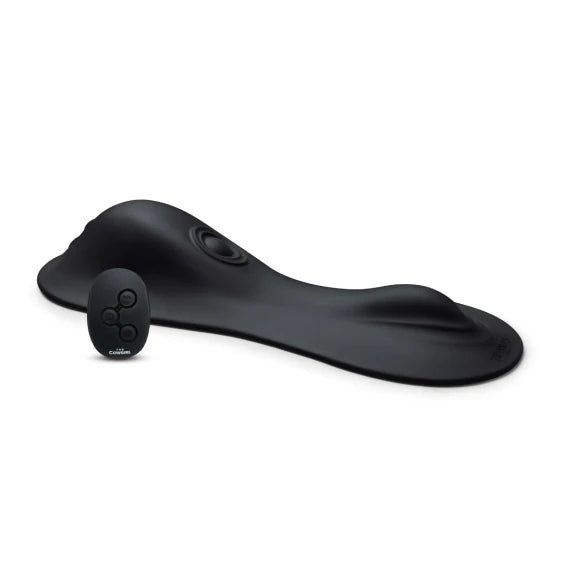
Cowgirl Rodeo Rumbler ride-on sex machine in black silicone, shown with its wireless remote

At a fraction of the price of anything else here, the Rumbler is the only machine on this list you can buy to find out whether you like the category at all, rather than committing to the answer in advance.

It is a ride-on: hands-free grinding with a clitoral tapper running independently of the vibration, so you can dial each separately. It publishes its numbers, which at this price is unusual — 68 decibels, one hour of use on a two-hour charge, 352 grams.

Not for you if you want penetration. This is external stimulation you ride, nothing more. And at 68 dB, it is louder than the Thrust Rider, the Lovense Mini and the Saddle Machine, which all publish 60.

Best rocking motion — Cowgirl Saddle Machine · $359.99
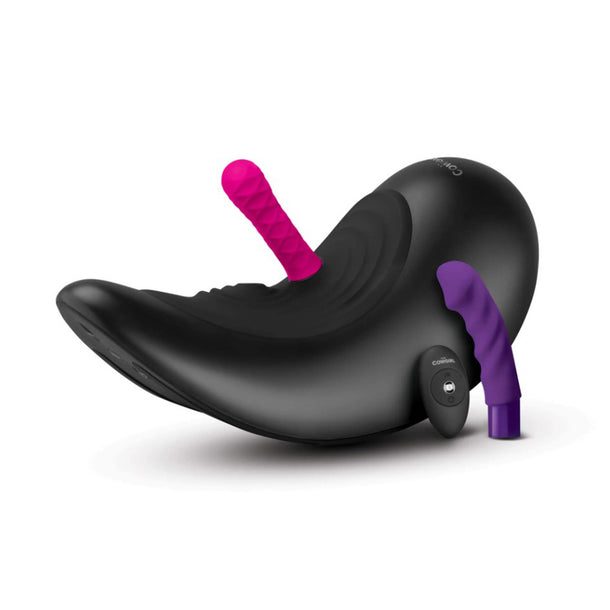
Cowgirl Saddle Machine, a black saddle-shaped ride-on, shown with both included attachments

A self-rocking saddle rather than a vibrating one — the motion mimics riding rather than buzzing, which is a genuinely different sensation and the reason people who find vibration numbing sometimes get on with this.

Two interchangeable attachments are included, and the vibration is mapped to the movement rather than running independently of it.

Not for you if you want data before you buy. Its own page publishes two different noise figures — 60 dB in one place, 72 dB in another — and little else.

Best compact thruster — Lovense Mini Sex Machine · $469.99
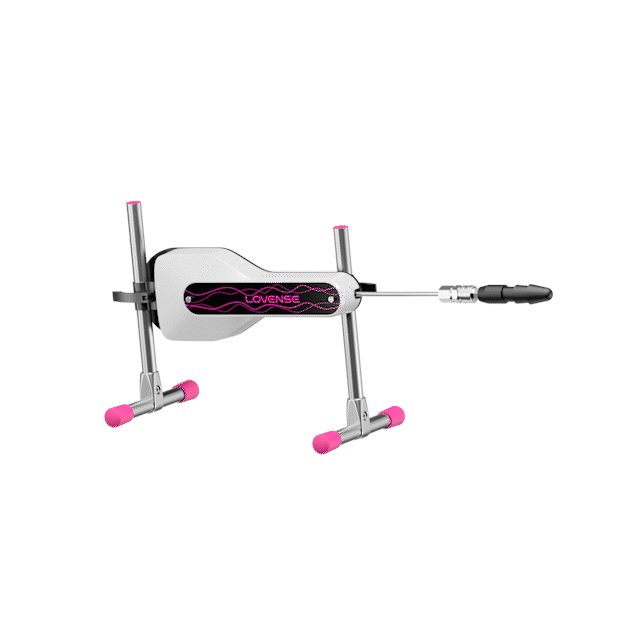
Lovense Mini Sex Machine, a compact thrusting frame on folding legs with adjustable angle

Up to 260 strokes per minute and 33 degrees of tool-free angle adjustment — the first real thrusting machine on this list, and the one that fits in a cupboard.

Angle adjustment is the spec to care about on any thrusting frame. A machine drives along a fixed axis, and if that axis does not match your body you will spend the session fighting it. Being able to change the angle without tools is the difference between a machine you use and one you resent.

Full app control comes as standard, including from another city.

Not for you if you want the stability of a heavy frame. Compact means light, and light means it needs a surface that helps.

Best published spec sheet — The Cowgirl Thrust Rider · $509.99
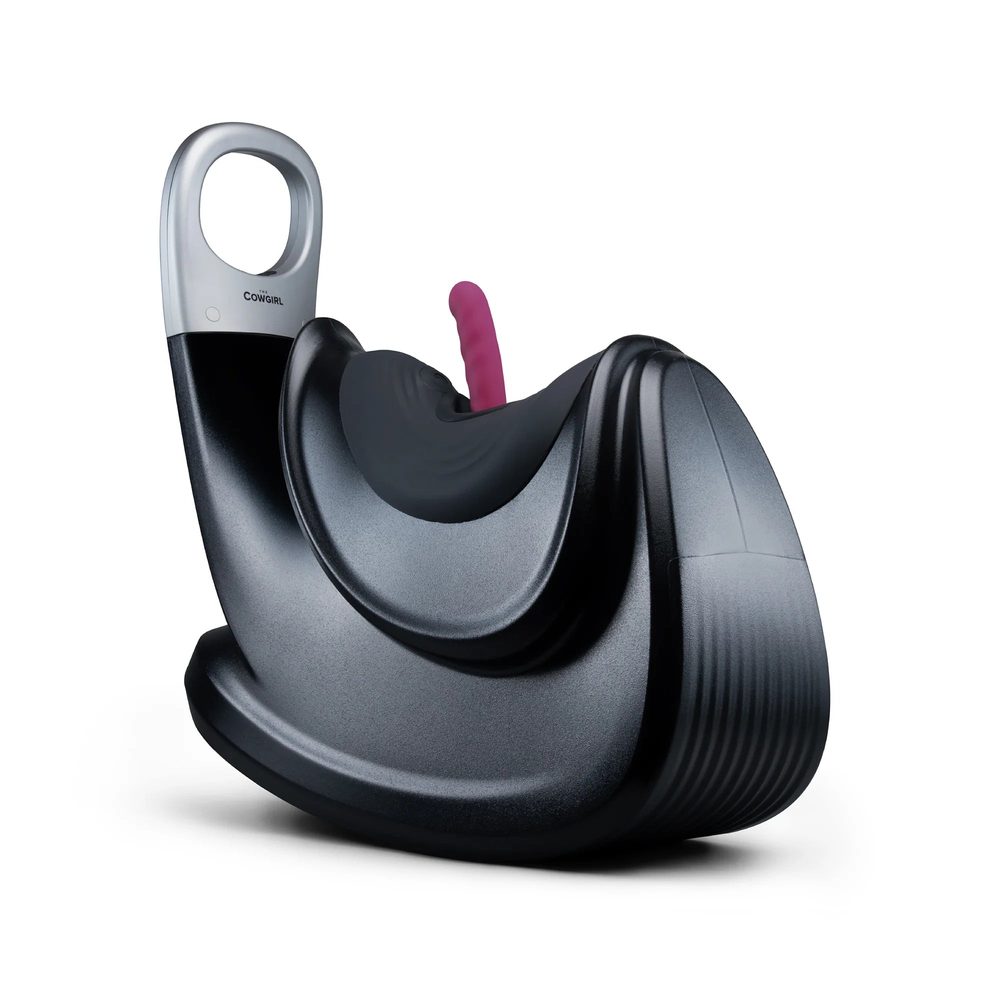
The Cowgirl Thrust Rider ride-on machine in black with a carry handle and ribbed body

The only device here that publishes everything you would want to know, and the reason it earns a place above machines that cost twice as much.

8 thrusting modes at five speeds each, up to 4 inches of variable depth, 6 clitoral tapping speeds, a 300 lb rider capacity, roughly 2 hours of use on a 4.5-hour charge, and a maximum of 60 decibels. An 11 lb base keeps it planted.

It is also the only one that combines both forms — it thrusts and rocks, with external tapping running alongside. If you cannot decide between the two halves of this category, this is the machine that refuses to make you.

Not for you if you want depth beyond 4 inches. That ceiling is published, which is more than most will tell you, but it is still a ceiling.

Best built — Kiiroo Pleasure Drive · $779.99
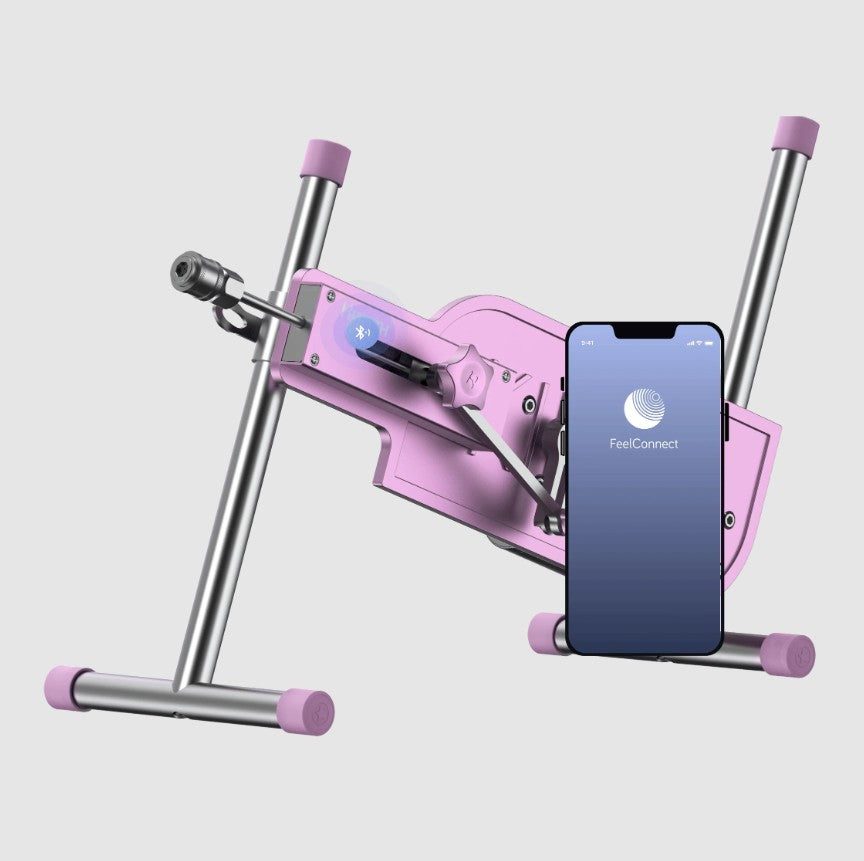
Kiiroo Pleasure Drive thrusting machine in pink and steel, shown beside its phone app control

Designed with HiSmith, a specialist sex-machine frame manufacturer, and built from 7 kilos of stainless steel and aluminium.

That mass is the feature. A thrusting machine pushes against you, and anything the machine’s own weight does not absorb goes into moving the machine — walking it across the floor, rattling, forcing you to reposition. Seven kilos does not walk anywhere.

An 18 cm silicone dildo is included, and it runs from the remote or the FeelConnect app for long-distance play.

Not for you if storage is tight. 7 kilos of steel is not something you slide under a bed one-handed.

Best for couples — Lovense Sex Machine · $1,199.99
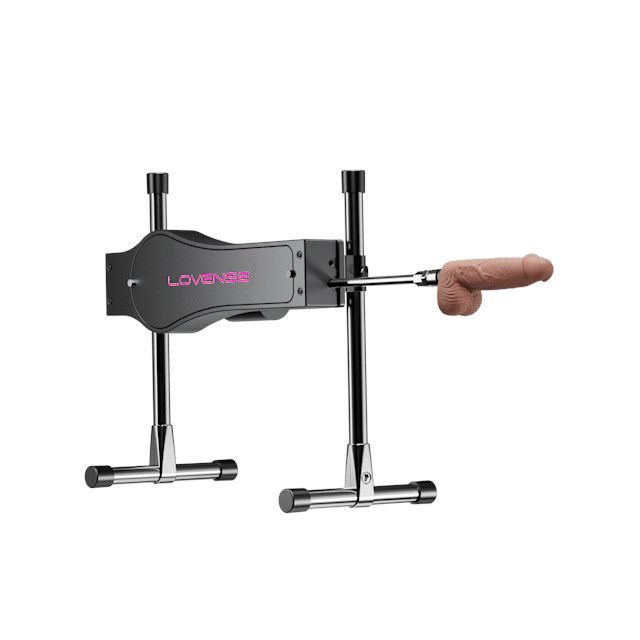
Lovense Sex Machine, a full-size dual-ended thrusting frame on a steel base

Up to 300 strokes per minute and up to 4.5 inches of stroke — the fastest and deepest published figures on this page — from a dual-ended frame that drives two people at once.

Both ends run simultaneously, which is a genuinely different proposition from one person operating a machine on another. Height and angle adjust fully, 7-inch and 6-inch silicone dildos are included, and Vac-U-Lock adaptors mean you are not locked into them.

Not for you if you are buying for solo use. You would be paying for a second end you never switch on — the Mini gives you the same brand’s thrusting for $730 less.

Best ride-on — The Unicorn Premium · $2,339.99
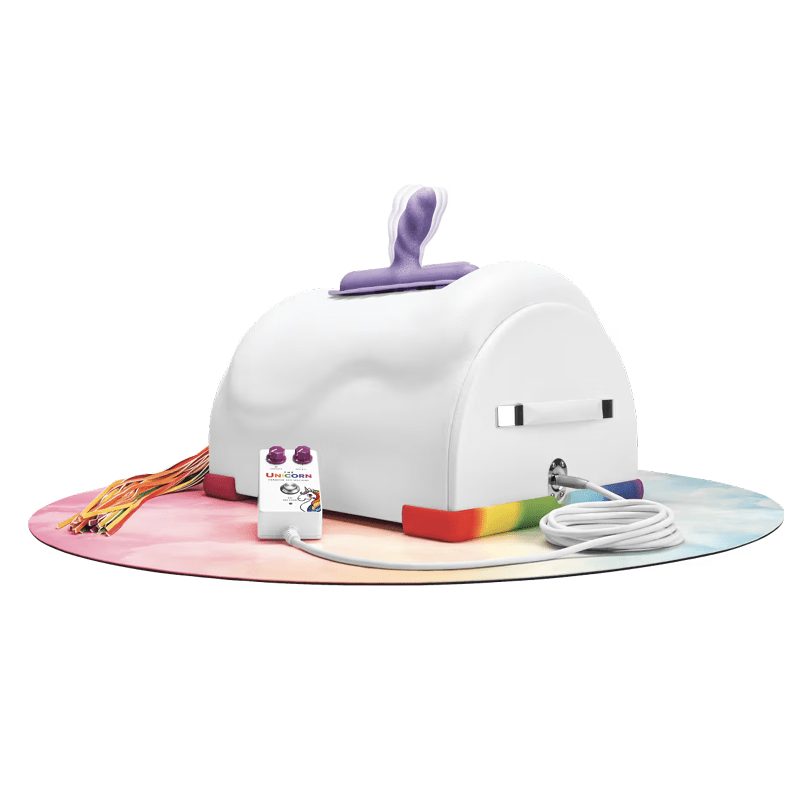
The Unicorn Premium riding sex machine in white, shown with its five-piece accessory set

6,500 RPM of vibration, 360-degree swivel rotation, and a 400 lb weight capacity — the highest published capacity here, and the spec that makes this the most genuinely inclusive machine on the list.

Vibration and rotation run independently. The five-piece set includes two attachments, a corded LED remote, a detachable flogger and a floor mat that exists because 6,500 RPM against a hard floor travels through a building.

Not for you if you want thrusting. This is rotation and vibration you ride — no stroke, no depth.

Best overall, if budget is not the constraint — The Cowgirl Premium · $2,419.99
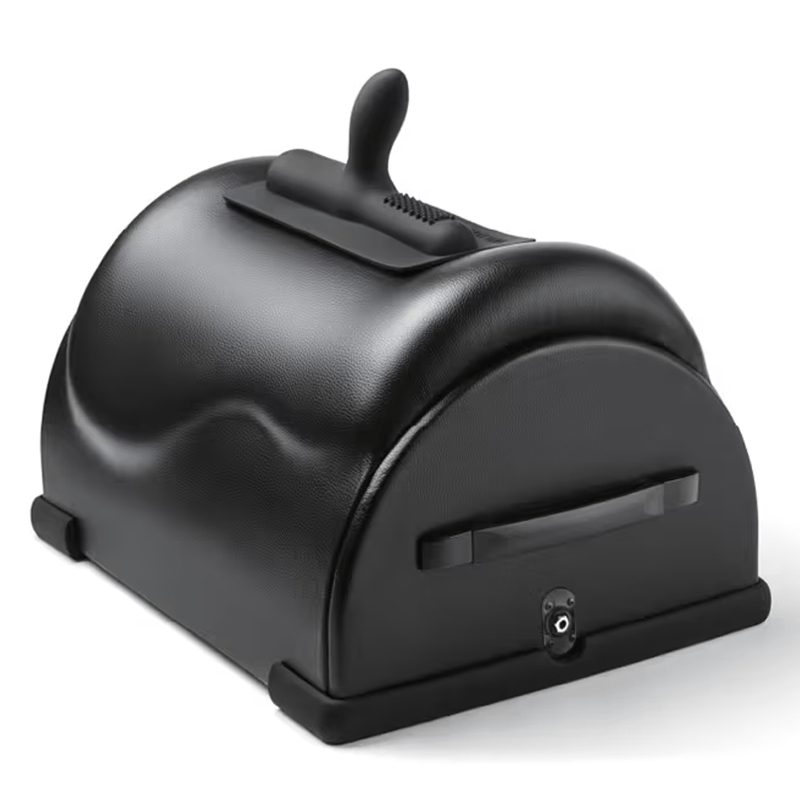
The Cowgirl Premium ride-on sex machine in black with a textured saddle top

The machine the rest of the ride-on category is measured against. 6 vibration patterns, 360 degrees of swivel rotation, up to 6,500 RPM, with vibration and rotation controlled separately.

What justifies the price is the saddle itself — padded, angled for ergonomic support, designed by a certified sex educator rather than an engineer working from a spec. On a device you sit on for an hour, the seat is not a detail.

Not for you if the Unicorn at $80.00 less does the same job with a higher weight capacity and more in the box. Compare the two properly before you spend.

What nobody tells you before you buy one

Decide ride-on or thrusting first. Everything else is detail. A ride-on is external, rhythmic and led by you; a thrusting frame is internal, relentless and led by the machine. People who buy the wrong one rarely fix it with settings.

Weight is a feature, not a shipping cost. The heaviest machines here are the ones that stay where you put them. Light frames need bracing, and bracing is work.

Storage is the real constraint. This is the least discreet category in the shop. Before you spend, decide where it lives when it is not in use — that question ends more purchases than price does.

You will need more lubricant than you think. A machine does not adjust or pause. Use a generous amount of water-based lubricant and reapply rather than pushing on.

Start at the lowest setting, every time. Even once you know the machine. Nothing here is gentle by default, and the slow end exists for a reason.

Quick answers

Cheapest way to try one? Cowgirl Rodeo Rumbler at $154.99.

Quietest published figure? A three-way tie at 60 dB — The Cowgirl Thrust Rider, the Lovense Mini and the Cowgirl Saddle Machine.

Fastest and deepest? Lovense Sex Machine — 300 strokes per minute, 4.5 inches.

Highest weight capacity? The Unicorn Premium — 400 lb.

Best for long distance? Kiiroo Pleasure Drive or the Lovense Mini.

If you only buy one? The Cowgirl Thrust Rider — it does both forms and tells you what it does.

Care, briefly

Attachments come off and get washed properly with a gentle cleanser; the frame or saddle gets wiped, never soaked. Check the fixings before each session on any machine that thrusts — a loose rod is the one failure in this category that is genuinely worth avoiding.

Finding your fit

Or browse the full sex machine collection with your two answers ready — ride-on or thrusting, and where it will live. If a machine is more than you want right now, thrusting vibrators deliver the same idea at a tenth the price and a fraction of the footprint. Everything ships across Canada in plain packaging, under a sender name that gives nothing away.


A sex machine is not a stronger vibrator. It is a machine that keeps a rhythm you did not have to maintain, which is a different thing to want — and the reason the people who love them describe them in terms of surrender rather than intensity.

Decide which half of the category you belong to, then buy the one that publishes its numbers. Everything else is a saddle you have not sat on yet.


Posted on — Leave a comment

A Gift Guide for Nights In: Four Bundles at Two Price Points

A Gift Guide for Nights In: Four Bundles at Two Price Points

By six most evenings, the light is already gone. Nobody has to suggest staying in anymore — it’s just what the evening becomes, and lately that’s felt less like settling and more like the actual plan.

A gift built for that evening is different from a gift built for an occasion. It doesn’t need one. That’s the whole idea behind a considered gift set, rather than a single item picked because it was the first thing on the page.

This gift guide breaks down four of them, at two different price points, built entirely from what’s actually in stock.

Four gift bundles. Two price points. Nothing pulled from a remainder bin.

What makes a bundle different from a single gift

A single product asks the giver to guess correctly once. A bundle spreads that risk across three or four smaller, more specific choices — something for the room, something for touch, something for the body — so the whole gift doesn’t rise or fall on one guess.

It also solves a real problem with gifting in this category. A single toy, given on its own, can read as an assumption about what someone wants. A set built around an evening, rather than a single act, reads as consideration instead of a guess. The Massage Indulgence Kit is a good example of the idea done small: five oils and a case, nothing in it to get wrong.

Why a bundle earns its place, and who it’s actually for

This only works if the pieces genuinely belong together. A toy and a candle bought separately and taped into one box is two gifts wearing a bow, not a bundle. What makes a real bundle worth the extra thought is sequencing — something for the room first, then something for the body.

It’s worth saying plainly who this isn’t for, too. Someone who already owns a considered personal massager doesn’t need a second one wrapped in ribbon. They need the specific thing they don’t have yet, and a bundle, by its nature, can’t guess at that as precisely as a single well-chosen item can. A bundle is for someone building a collection from close to zero, not someone refining one.

What this gift guide looks for in a bundle

The honest answer is fewer, better pieces over more, smaller ones. Three to four items is enough to feel considered without turning into a grab bag; past that, a bundle starts to read as padding rather than curation.

Solo or together

The first real decision is who’s actually going to use it. A solo bundle can go heavier on one hero product, because there’s only one set of preferences to satisfy. A couples bundle needs something both people can use without either one feeling like an afterthought — a narrower brief, and worth settling before anything else.

Sensory-first or toy-first

Not every bundle needs a vibrator as its anchor. A massage oil candle and a premium lubricant can carry an entire evening on their own, for a recipient who’d rather ease into things than start with a toy already in hand. The toy-forward version is the more obvious gift. The sensory-first version is often the more considered one.

Budget, and how far it goes

A lower-tier bundle built around a discreet bullet vibrator still reads as complete at three items. A higher-tier bundle earns the extra spend by including one genuine hero piece — something like the ENIGMA Deep Rose, which combines clitoral and G-spot stimulation in a single device — rather than by simply adding a fourth accessory to a set that was already whole at three.

Quiet enough for a shared space

This is the detail almost no gift guide checks, and it matters more than most of the others. The Le Wand Dive publishes a maximum noise level of ≤68dB alongside a fully IPX8-waterproof build and roughly two hours of use time per charge. The Le Wand Petite, in the All That Glimmers set, runs slightly louder at under 72dB, with ten intensity levels and about an hour of use per charge. Those are two of the only published noise figures across everything in this guide — most listings simply don’t say, which is itself worth knowing before buying for a thin-walled apartment or a shared house.

How to give it so it feels considered, not clinical

Skip the single-word note. Whatever’s in the box, the words around it do more work than the ribbon. “For the version of us that isn’t rushing anywhere” says more than any card that just says enjoy.

Let the recipient open the room-focused piece first. A candle or a massage oil sets a slower pace for whatever comes after it, and starting there turns the whole bundle into a sequence instead of a pile.

The trade-offs: when a bundle is right, and when it isn’t

A bundle is the right gift for someone building a collection from close to zero, or for a couple who’d rather have one evening handled than make three separate decisions. It’s the wrong gift for someone who already owns the basics and would rather choose their own next purchase — for that person, a single well-chosen luxury vibrator or a gift card reads as more considered than a set they’ll only use one piece of.

It’s worth saying plainly, too: nothing in a bundle like this fixes a mismatched evening on its own. The pieces make good conditions more likely. They don’t manufacture desire that isn’t there to begin with.

Care and storage

Body-safe silicone toys clean with warm water and a toy-specific cleaner, never anything with alcohol, before they go back in a drawer. Massage oil candles want a trimmed wick and a fully melted top layer each use, or they tunnel down the middle instead of burning evenly. Water-based and silicone lubricants both keep well in a cool, dark place — and a silicone lubricant should be stored away from silicone toys specifically, since sustained contact between the two can degrade the toy’s surface.

Finding your fit

Lower tier

  • The Slow Evening — $229.97. Duet Bullet, Lilac, a multi-surfaced silicone bullet built for both external and shallow internal use. Überlube, a silicone lubricant designed to transfer sensation rather than just reduce friction. Massage Oil Candle, Soft Touch, a benzoin-and-sandalwood blend that melts into a usable massage oil.
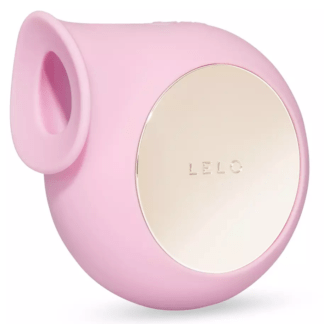
  • Warm Welcome — $264.97. The Massage Indulgence Kit, five travel-sized massage oils in one case. Mia 2, LELO’s lipstick-style clitoral vibrator, waterproof to one metre with 1.5 hours of continuous use per charge. SUTIL Pure, a pH-balanced water-based lubricant.

Higher tier

All four are built from real, in-stock pieces — every item here is something we’d sell on its own, not a wholesaler’s remainder bin.


A gift bundle isn’t really about the number of items in the box. It’s a bet that a slower evening, handled with a little more intention than usual, is worth more than any single object inside it.

Whichever tier fits, the point was never the box. It’s what an ordinary Tuesday can become when someone thought about it in advance.

Posted on

Chastity Cage Sizing Guide

Chastity Cage Sizing Guide

If a cage pinches, goes numb, or you cannot stop thinking about it, the problem is almost never you. It is almost always one of three measurements — and most people only ever take one of them.

A well-fitted device should fade into the background until you decide it matters. Here is how to get there, and one honest shortcut at the end.

The three numbers that decide the fit

Most sizing mistakes come from chasing length, because length is the number on the front of the box. Fit is a balance of three variables, and getting two right still leaves you uncomfortable.

Base ring diameter is the foundation. It sets how the device anchors and carries the weight.

Cage internal diameter controls how much room there is inside the tube.

Cage length controls forward space. It is the least important of the three and gets the most attention.

Prioritise in that order: ring first, diameter second, length last.

How to measure the base ring

This is the measurement that decides whether a device is wearable for hours or unwearable after twenty minutes.

Measure circumference and convert. Use a soft tape, or a strip of paper and a ruler. Measure soft, standing, with everything relaxed — measuring while aroused or lying down gives you a number that will not hold.

Wrap the tape around the shaft and behind the testicles, where the ring will actually sit. Snug, not tight. Then divide the circumference by 3.14 to get the diameter you need.

Measure three times across a day. Bodies change with temperature and time of day, and the average of three is far more useful than one confident reading.

How to measure length — and why to go shorter

Measure from the base to the tip while soft. Then buy shorter than that number.

A cage matching your full soft length leaves space to move into, which is exactly what you are trying to avoid. Most people are best served by something noticeably shorter than their measurement, and almost nobody regrets going shorter.

The signs you got it wrong

Learn these, because the fix is different for each.

Pinching at the base means the ring is too small, or skin is being caught when you put it on. Never solve this by forcing it.

Slipping or rotating means the ring is too large. A device that moves will chafe, and chafing is what ends long wear.

Numbness, coldness, colour change, or pins and needles is circulation, and it is the one that is not a comfort issue. Remove the device immediately and do not put it back on until everything has returned to normal. If it does not, seek medical advice rather than waiting it out. No sizing chart is worth an injury.

Constant awareness — not pain, just never being able to forget it — usually means the length is wrong rather than the ring.

The honest shortcut: skip rigid entirely

Everything above assumes a rigid device with fixed measurements. That is the format that creates the sizing problem in the first place.

Both devices we stock take the other approach. COCK-LOCK at $79.99 is a soft, super-stretchy cage with no locks and no rigid parts — it fits any size because it deforms to whatever it is on, and doubles as a bulge-enhancing packer. MEATLOCKER at $94.99 is Oxballs’ first full-cover device, made from a silicone-TPR blend that stretches to fit and grips like a glove, built specifically for long-term comfortable wear.

Neither will satisfy someone who wants a locked steel device, and we are not pretending otherwise. But if you are sizing for comfort and long wear rather than security, the honest answer is that the measuring problem is avoidable.

The trade-offs: soft versus rigid

Soft is right if this is new to you, if you want to wear it for hours, if you are still learning your measurements, or if the appeal is sensation and presence rather than genuine denial. It is also the format you can stop wearing in three seconds, which matters more than people admit when they are starting out.

Rigid is right if security is the actual point — if the device needs to be something you cannot simply remove. That is a different want, and a legitimate one. We do not currently stock it, and a soft cage will not scratch that itch.

If what you are after is the dynamic rather than the hardware, that lives in bondage and kink more broadly — restraints and cock rings both build a sense of control without a fit problem to solve.

Wearing it well

Start with short sessions. An hour, then an evening, then overnight — in that order, over weeks rather than days. Skin needs time to adapt and you need time to learn what normal feels like, so that abnormal is obvious.

A little water-based lubricant makes putting it on far easier and prevents the skin-catching that causes most base pinching.

Clean daily with warm water and a gentle cleanser, and dry thoroughly. Anything worn against skin for hours needs more hygiene attention than a toy used for twenty minutes, not less.

And if you are wearing one with a partner holding the terms, agree in advance how it comes off in an emergency. That conversation is not a mood-killer; it is what makes the rest of it possible.

Finding your fit

  • COCK-LOCK · $79.99 — soft, stretchy, no locks or rigid parts. Fits any size, doubles as a packer. The least committal way in.
  • MEATLOCKER · $94.99 — full-cover, silicone-TPR blend, built for long-term wear. Stretches to fit rather than requiring a size.

Both sit in chastity, and both sidestep the measuring exercise entirely. If you want the wider picture on power exchange and where devices fit into it, the bondage and kink range is the place to start. Everything ships across Canada in plain packaging, under a sender name that gives nothing away.


A cage that fits is one you stop noticing. That is the whole target — not tighter, not smaller, not more punishing. Just correct enough to disappear until you want it not to.

Measure three times, buy shorter than you think, and pay attention to what your body reports back in the first week. It will tell you everything a sizing chart cannot.

Posted on

Best Positions for a Thrusting Vibrator

Best Positions for a Thrusting Vibrator

Two people can use the same thrusting vibrator, on the same setting, and have completely different evenings. Not because one of them is doing it wrong — because of the angle between the toy and their body.

With most toys, position is a preference. With a thrusting vibrator it is a variable, and it changes more than the settings do.

Why position matters more here than anywhere else

A standard vibrator stays where you put it. The sensation radiates from a fixed point, so the exact angle you hold it at barely registers.

A thrusting toy moves along an axis. Every cycle, the shaft travels in one specific direction — and what it meets on the way depends entirely on where that axis is pointing. Tilt it slightly forward and the stroke loads the front wall. Keep it neutral and the pressure spreads. Angle it back and you are stimulating something else entirely.

Shift your hips two centimetres and you have changed the toy. That is the whole thing, and almost nobody says it plainly.

The three variables you are actually adjusting

Every position below is a different combination of the same three things. Once you can name them, you can invent your own instead of following a list.

Angle — the one that changes the sensation

Where the shaft points when it extends. This is the variable with the largest effect and the one most people never deliberately adjust.

Some toys let you set it mechanically rather than with your body. Spinel publishes up to 150 degrees of angle adjustment and mounts hands-free, which makes it the easiest toy we stock to experiment with — you can change the angle without changing your position, and isolate what the angle alone is doing.

Depth — set by your body, not the toy

Almost nothing in this category has adjustable depth at a sane price. What you control instead is how much of the insertable length you actually use, and that is a function of position.

Published lengths help you plan. Dorcel Deep Thrust lists 4.31 inches insertable; Spinel lists a 6.18-inch total length. Positions that stack your hips shorten the effective depth; positions that flatten you out lengthen it.

Whether your hands are involved

Holding a thrusting toy means bracing against its motion, and bracing is work. It is the reason sessions end earlier than people expect.

Anything with a suction base solves it: ROMP Jiggle at $84.99 and Lovense Gravity at $219.99 both anchor to a hard surface and stay there. Bi Stronic Fusion is hands-free once positioned without needing a surface at all.

Solo positions

On your back, hips raised

The default, and the one worth getting right before trying anything else. Lying flat, the natural angle of most toys points slightly downward. Raising your hips tilts the axis forward and loads the front wall.

You can do this with a folded pillow. You can also do it properly — a wedge like Bonbon at $179.99 holds the angle without collapsing halfway through, which is the entire difference between a position you hold and a position you keep rebuilding.

Start here if you are new to the category. It is the most controllable position and the easiest to abandon if the sensation is not what you expected.

Kneeling over a mounted toy

Suction the toy to a firm floor or the base of a bath and lower yourself onto it. Your body weight sets the depth, and gravity does the work your arms were doing.

This is the position that makes Gravity make sense — its published 1.18-inch stroke at up to 140 strokes per minute reads as insistent rather than overwhelming, which is what you want when you are not in control of the pace.

Not for you if your knees object. It is a genuinely demanding position and it is fine to skip it.

Side-lying

The most underrated position here, and the most sustainable. Lying on your side with knees drawn up shortens the effective depth and angles the stroke gently — which suits shorter toys and anyone who finds deep pressure too much.

It is also the only position on this list you can hold for an hour. If a toy’s runtime matters to you, this is where you will find out — Spinel publishes up to 257 minutes, which is by some distance the longest in our thrusting range.

Seated, upright

Sitting changes the internal geometry entirely — the angle steepens and the front wall comes forward. Some people find this is the position where a toy they had written off suddenly works.

A firm edge helps. So does something to lean against; the Humphrey at $239.99 is built for exactly this kind of supported upright position.

Partnered positions

Spooning, partner operating

The gentlest way to bring a thrusting toy into shared intimacy. You keep the side-lying angle, your partner controls pace and depth, and nobody has to be athletic about it.

The Arie Duo spooning pillow at $199.99 exists for this position specifically, which tells you it is more common than the internet suggests.

One toy each, facing

Both partners using the toy simultaneously rather than one operating on the other. Together Double Delight at $169.99 is dual-ended with central controls both people can reach — built for this and not much else.

Not for you if you wanted a solo hands-free toy. It needs two people to earn its price.

Remote control, from across the room — or further

Position stops being physical and becomes a question of who holds the pace. Lovense Vulse at $169.99 runs 120 strokes per minute under full app control, including from another city.

This is the one position where handing over control is the point rather than a side effect, and it changes the experience more than any angle does.

What actually goes wrong

The surface is not firm enough. Suction bases need glass, tile, sealed wood or a hard floor. A mattress or a textured bath will not hold, and the toy shifting mid-session is the fastest way to lose the thread.

You are fighting the toy instead of positioning it. If you are bracing, the position is wrong. Change the angle before you change the setting.

Not enough lubricant. A thrusting toy moves continuously, and continuous movement needs more water-based lubricant than a static one — reapplied, not just applied.

Starting at the speed you finished at last time. The stroke needs a moment to stop reading as mechanical. Start slower than you think and let it build.

The trade-offs

Hands-free positions are more sustainable but less responsive — you cannot make micro-adjustments mid-stroke. Held positions give you that control and cost you endurance.

Furniture solves the endurance problem properly, and it is a real purchase rather than an accessory. A positioning bar at $94.99 is the cheapest way in; a full piece is a considered decision, not an impulse.

And if none of these positions produce what you are after, the honest possibility is that thrusting is not your sensation. That is not a failure of technique — some bodies want vibration rather than movement, and our guide to choosing a vibrator works through that fork properly.

Care, briefly

Warm water and a gentle cleanser before and after, with attention to the seam where the shaft enters the housing — that is where a thrusting toy needs cleaning most and gets it least. Dry fully before storing.

Finding your fit

Positions and toys are not independent choices. These pair well with the positions above.

  • ROMP Jiggle · $84.99 — strong suction base, light, short stroke. The cheapest way to try mounted positions.
  • Dorcel Deep Thrust · $119.99 — 50 dB published and 4.31 inches insertable. The quiet one, and the one to pick for side-lying.
  • Bi Stronic Fusion · $149.99 — genuinely hands-free once positioned, no surface required.
  • Lovense Vulse · $169.99 — 120 strokes per minute under app control, near or far.
  • Together Double Delight · $169.99 — dual-ended, central controls, built for facing positions.
  • Lovense Gravity · $219.99 — 1.18-inch stroke, 140 strokes per minute, true suction-cup mounting.
  • Lovense Spinel · $249.99 — 150 degrees of angle adjustment and 257 minutes of runtime. The one to buy if you intend to experiment.

For the positions that need support: the Pivot Positioning Bar at $94.99, Bonbon at $179.99 for hip elevation, and the Arie Duo at $199.99 for partnered side-lying.

New to the category entirely? Our guide to thrusting vibrators and penetration-led pleasure covers stroke, pace, shape and noise before you spend anything. Everything ships across Canada in plain packaging, under a sender name that gives nothing away.


There is no correct position. There is the angle your body answers to, and the only way to find it is to change one thing at a time and pay attention.

Move your hips before you touch the speed dial. Most of what people are looking for in a higher setting was available two centimetres away.

Posted on

Twitch 2 Vibrator Review

Twitch 2 Vibrator Review

Three motors. Ten speeds each. Two separate pieces that talk to each other without an app. On paper the Twitch 2 answers a question a lot of people actually have — why should I choose between external and internal?

The idea is sound. The execution has one ceiling that decides whether you’ll love it or shelve it, and it is not the one the box warns you about.

First, the honest disclosure

We do not stock the Twitch 2. It was on our previous storefront and Shots is not a brand our current supplier carries, so there is nothing for us to sell you at the end of this review.

The review stays up because the question behind it is a good one, and because the toys that answer it best are ones we do carry. Where that matters, we will say so plainly — including where they cost more.

What the Twitch 2 actually is

Two pieces. A dual-ended external stimulator — a flapping tongue on one end, a clitoral suction mouth on the other — and a separate insertable vibrating egg. Three motors between them, ten speed modes each, and the external unit doubles as the egg’s remote.

That last detail is the quietly clever one. No Bluetooth pairing, no app update at eleven at night, no dead phone ending the evening. The remote is a toy you are already holding.

Both pieces are waterproof, which is less common at this price than it should be, and the silicone reads as more expensive than $124.

The ceiling nobody mentions until it happens

Battery. Three motors drawing from small cells means the Twitch 2 runs out before a long session does, and you end up charging it more often than you use it.

This is the single most common reason a multi-motor toy goes in a drawer, and it is the spec almost nobody shops for. Runtime is not a luxury feature. It is the difference between a toy you reach for and a toy you have to plan around.

Which is why it is worth naming the brands that print the number. Sona 3 Cruise publishes up to 2 hours of use on a 2-hour charge, with a 520 mAh cell and 90 days of standby. Moxie+ publishes up to 2 hours on a 90-minute charge. Those are figures you can plan an evening around.

The second spec worth knowing: the Twitch 2 measures 60 decibels. That is not loud, but it is conversation-across-a-room rather than fridge-in-the-next-flat. If you share thin walls, treat it accordingly.

What to look for in a dual-stimulation toy

Four things separate the ones people keep using from the ones that get charged once and forgotten.

1. One device or two

Two pieces give you independence — external and internal can run at different intensities, and either can be used alone. The cost is two things to charge, two things to clean, two things to lose.

One device that does both is simpler and usually better made at the same price. Enigma is the clearest example we carry: sonic waves against the clitoris and gentle pulses internally, at the same time, from one body. Eight settings rather than thirty, which is the trade — fewer options, better executed.

2. Suction, sonic, or tongue — they are not the same sensation

The Twitch 2 offers a suction mouth and a flapping tongue, and treats them as two flavours of the same thing. They are not.

Suction pulls. Sonic waves press without contact, which suits people who find direct clitoral pressure too sharp — that is what Sila Cruise is built around, with a deliberately wider mouth for broader coverage. A rotating tongue, like the one in Ora 3 with its 12 modes, is a moving, circling sensation rather than a pulsing one.

Knowing which of the three your body answers to narrows the whole clitoral range faster than any feature list.

3. Whether a phone is involved

The Twitch 2’s no-app remote is a genuine advantage and an obvious limitation in the same breath: it works across a room, not across a country.

If in-the-room control is what you want, Tiani Duo runs two motors from a motion-sensitive remote — you change the intensity with a flick of the wrist rather than a menu. If you want distance, that is a different purchase entirely, and the app-controlled range is where to look.

4. How many modes you will genuinely use

Thirty settings across three motors sounds generous. In practice most people find two they like and stay there.

Mode count is the easiest number for a brand to inflate and the least useful one to shop on. What matters is whether the low end is genuinely low — the harder thing to engineer, and the setting more people actually use.

The trade-offs: when the Twitch 2 is right, and when it is not

It is right if you specifically want external and internal running independently, you like the idea of a remote that is also a toy, and your sessions are short enough that battery is not the deciding factor.

It is wrong if this is your first or second toy — a two-piece system is a lot of decisions to make before you know what you like. Start with one function, learn your preference, then buy for it. Lily 2 at $109.99 or Volta at $109.99 are better first purchases than anything with three motors.

It is also wrong if you want long-distance play, or if you need endurance more than variety. And it is worth saying plainly: the toys we would put in its place cost more — $177 to $230 rather than $124. What you get for the difference is published runtime, better silicone and a single device instead of two. Whether that is worth seventy dollars is a fair question, and the answer depends on how often you would actually reach for it.

Care, briefly

Warm water and a gentle cleanser before and after use, dried fully before storage. Anything with a suction mouth or a moving tongue needs the recess cleaned properly rather than wiped — that is where a toy starts to smell before it starts to fail.

Pair silicone with a water-based lubricant rather than a silicone one, which degrades the surface over time.

Finding your fit

If the Twitch 2’s dual-stimulation promise is what brought you here, these answer the same want from stock we actually hold.

  • Volta · $109.99 — flexible fluttering tips, external only. The least intimidating way to find out whether you like this kind of sensation at all.
  • Lily 2 · $109.99 — small, quiet, deliberately simple. A first toy rather than a fourth.
  • Moxie+ · $124.99 — wearable and magnetically held, 10 modes, IPX7, and a published 2-hour runtime on a 90-minute charge.
  • Ora 3 · $179.99 — a rotating tongue node with 12 modes. The closest thing we stock to the Twitch’s tongue end, executed far better.
  • Sila Cruise · $184.99 — sonic rather than suction, with a wider mouth for broad, indirect pressure. For people who find direct contact too sharp.
  • Tiani Duo · $194.99 — two motors, eight settings, motion-sensitive remote. Wearable during sex.
  • Enigma · $229.99 — sonic clitoral and internal pulses simultaneously, in one device. The single best answer to what the Twitch 2 was trying to do.
  • Sona 3 Cruise · $229.99 — the fullest published spec sheet here: 112 × 51 × 55 mm, 128 g, 2-hour runtime, 90-day standby.

Or browse the whole clitoral collection and the couples range with your two answers in hand — which sensation, and how long you need it to last. If you are earlier in the decision than that, our guide to choosing a vibrator works through placement, intensity, pattern, size and noise before you spend anything. Everything ships across Canada in plain packaging, under a sender name that gives nothing away.


The Twitch 2 got the question right. Wanting external and internal at once is not greedy or advanced — it is just how a lot of bodies work, and for a long time the market treated it as a niche.

What it got wrong was assuming more motors was the answer. The better answer turned out to be fewer, running longer, in one hand.

Posted on

Best Thrusting Vibrators in Canada 2026

Best Thrusting Vibrators in Canada 2026

Most “best thrusting vibrator” lists are written by people who have never held one. You can tell, because they rank by price and call everything powerful.

This one ranks the thrusting vibrators we actually stock by the things that change the experience — how far the toy travels, how fast, how loud, and whether the shape suits what your body responds to. Where a manufacturer publishes a real number, it is here. Where they do not, that is here too, because a spec nobody will print is worth knowing about.

Fourteen toys, all in stock, all shipped discreetly across Canada.

How these are ranked

Not by price, and not by star ratings we cannot verify. By four things:

Stroke length — the distance travelled per thrust. Almost nobody publishes it. Two of these do.

Pace — strokes per minute, and whether the slow end is genuinely slow.

Noise — one brand in this list publishes a decibel figure. One.

Shape — curve, head profile and girth, because sensation is architecture.

Every product below is one we stock, at the price you will actually pay.


Best overall — Fun Factory Bi Stronic Fusion · $149.99

Fun Factory invented the pulsator category, and it shows. The Bi Stronic Fusion pairs a thrusting shaft with clitoral vibration and vibrating wings against the labia, and it is genuinely hands-free once positioned — which is rarer than the marketing suggests.

It sits mid-price, mid-stroke and mid-intensity, which sounds like faint praise and is actually the point: it is the one most bodies get along with. If you are buying one thrusting toy and want the highest chance of loving it, this is the pick.

Not for you if you want a long, deep stroke. The Stronic movement is deliberate rather than dramatic.

Best for beginners — ROMP Jiggle · $84.99

The cheapest thruster we stock and the gentlest way in. Short stroke, strong suction base, and light enough that you stop thinking about holding it.

At $84.99 it is the only one in this list you can buy to find out whether you like thrusting at all, rather than committing to the answer in advance.

Not for you if you already know you want depth. You will outgrow it.

Quietest — Dorcel Deep Thrust · $119.99

50 decibels. That is a published, measured figure, and Dorcel is the only brand in this list willing to print one. For context, 50 dB is a quiet room, or a fridge humming next door.

It gets there with magnetic thrusting rather than a conventional gear motor, which removes most of the mechanical whine. Insertable length is 4.31 inches, also published, and the remote works to about 10 metres.

If you live with roommates, thin walls, or children who wake easily, buy this one. The decision is that simple.

Not for you if you want a clitoral arm — this is a single-focus toy.

Best published stroke — Lovense Gravity · $219.99

1.18-inch stroke, up to 140 strokes per minute. Two real numbers, which makes Gravity the only toy here you can evaluate before it arrives.

The suction cup means true hands-free against a wall, floor or chair, and the app opens up pattern control and long-distance play. The stroke is moderate, deliberately — it reads as insistent rather than punishing.

Not for you if you want something discreet in a drawer. It is a full-size dildo form factor.

Best for G-spot — Dorcel G-Stormer · $199.99

A linear motor behind a curved, firmer head, with seven up-and-down speeds. Linear motors move in a straight reciprocating line rather than converting rotation, which is why the stroke feels cleaner and more directed than most.

The curve is pronounced enough to hold pressure at the front wall without you fighting the angle.

Not for you if you are sensitive to firm internal pressure. This one commits.

Best app-controlled — Lovense Vulse · $169.99

120 strokes per minute, full app control, and genuine long-distance operation — a partner can drive it from another city.

Vulse is the one to buy if the appeal is handing over control rather than holding it. It also syncs to music and responds to sound, which is either delightful or gimmicky depending on your temperament.

Not for you if you would rather not involve a phone. The onboard controls are limited.

Best for couples — Together Double Delight · $169.99

Dual-ended and ribbed, with ten thrusting and vibration levels on central controls both partners can reach. Built for simultaneous use rather than one person operating a toy on another.

Not for you if you want solo hands-free. It needs a second pair of hands to earn its price.

Best blended sensation — Le Wand Thrust Rabbit · $139.99

A curved thrusting shaft aimed at the G-spot with a dedicated clitoral vibrator, from a brand whose finish quality is unusually good at this price. Le Wand’s silicone has almost no drag, which matters more on a thrusting toy than a static one.

Not for you if the clitoral arm does not sit where you need it. Rabbit geometry is personal, and no rabbit fits everyone.

Best two-sensation design — Dorcel Power Ride · $164.99

Dual motors: deep internal thrusting plus rapid external tapping you can reposition. Tapping is a distinctly different sensation from vibration — sharper, more percussive — and pairing it with a slow thrust is a combination most rabbits cannot produce.

Its sibling in feel is the Love to Love Sassy Bunny at the same $164.99, which runs the same thrust-plus-tap idea in a softer silhouette.

Best splurge — Lovense Spinel · $249.99

Thrusting, vibration and heating in one device, with 150 degrees of angle adjustment, a hands-free mount, and interchangeable attachments that switch it between clitoral, G-spot and classic shapes.

It is the most adjustable toy we stock, which makes it the closest thing to buying three toys at once. The warming is not a gimmick either — silicone at body temperature feels considerably less like an object.

Not for you if you want to take it out of the box and use it. There is a learning curve.

The rest of the range

  • Fun Factory Sundaze · $149.99 — pulsing, thrusting, stroking and fluttering, hands-free. The Bi Stronic’s more experimental sibling.
  • Dorcel Furious Rabbit · $89.99 — three up-and-down and rotating modes with a seven-speed clitoral arm. The best-value triple-stimulation toy here.
  • Dorcel Furious Rabbit 2.0 · $134.99 — dual motors, auto-thrusting head, rotating beads. Everything the original does, with more behind it.

What nobody tells you about buying one of these

Louder is not better, and it is not even neutral. A thrusting motor doing more mechanical work makes more noise, and a toy you feel self-conscious using is a toy you stop reaching for. This is the most common reason a thrusting vibrator ends up in a drawer.

Stroke length matters more than motor power. A quarter-inch stroke and a two-inch stroke are different experiences, not different intensities of the same one. Power sells; travel is what you feel.

Adjustable depth barely exists. Plenty of guides tell you to look for it. Almost nothing in this category offers it at a sane price, so choose the fixed stroke that suits you rather than hunting a feature that mostly is not there.

If you are unsure, start shorter. It is far easier to graduate up than to talk your body into something that felt like too much on day one.

Quick answers

Cheapest way to try thrusting? ROMP Jiggle at $84.99.

Quietest? Dorcel Deep Thrust — 50 dB, published.

Best for long distance? Lovense Vulse.

If you only buy one? Bi Stronic Fusion.

Care, briefly

Wash with a gentle cleanser after every session and dry it fully before storing — a thrusting shaft has a moving seam, and water sits in it. With silicone, use a water-based lubricant rather than a silicone one; silicone lube can soften and degrade a silicone surface over time. If a toy is going unused for months, top the battery up occasionally rather than leaving it flat.


New to the category? Our guide to thrusting vibrators and penetration-led pleasure walks through stroke length, pace, shape and noise before you spend anything. Or browse the full Thrusting Vibrators collection — fourteen options from $84.99 to $249.99, every one in stock, shipped in plain packaging under a sender name that gives nothing away.

A best-of list is not really a ranking. It is fourteen different answers to the question of what your body responds to, and the only wrong pick is the one chosen because it was loudest in the marketing.

Start with the spec that matters most to you — the stroke, the decibels, the price — and let the rest follow.

Posted on — Leave a comment

The Conversation Before the Conversation

The Conversation Before the Conversation

There’s a sentence you’ve rehearsed in your head for two weeks.
You’ve run it a dozen different ways, softened it, sharpened it, picked
the exact right unhurried moment for it — and it’s still sitting there,
unsaid. Nothing about the sentence itself is dangerous. It’s a question,
not a confession. But somewhere in the rehearsing it turned into
something that has to be gotten right, which is exactly why it keeps not
happening.

The gap nobody names
correctly

A study of 101 couples found that open communication about sex
predicted sexual satisfaction far more strongly than general
communication did — a correlation of .67 versus .29. The couples in
question weren’t bad communicators. They talked about money, schedules,
family, all of it, competently. The one category that lagged,
consistently, was this one — and it’s the category that turned out to
matter most for how satisfied they actually were.

That’s worth sitting with. Good general communication doesn’t
transfer automatically to this specific kind. Being easy to talk to
about everything else doesn’t make the one sentence any easier to
start.

Why it feels like “A Talk”

The reason it stalls isn’t the topic. It’s the shape people give it
in their heads. A new interest, said out loud, gets treated like a
proposal that needs a yes or no on the spot — which means the person
hearing it has to produce an instant, considered verdict about something
they’ve maybe never thought about, and the person saying it has to
survive whatever that verdict turns out to be. Both sides are bracing
for a moment that was never supposed to be this heavy. The stakes are
self-inflicted, built entirely out of how the sentence gets framed
before it’s ever spoken.

The conversation
before the conversation

There’s a version of this that doesn’t require the rehearsal at all.
It’s smaller, curious, and reversible: I read something about this
the other day — ever thought about it?
Nothing in that sentence
asks for a yes. Nothing in it commits either person to anything. It’s
not a proposal, it’s a question about a question — an opening, not a
pitch.

That distinction changes everything about how it lands. A proposal
has to be answered. A curious remark can be shrugged at, laughed off,
sat with for a week, or picked back up later without either person
having staged a moment neither can walk back from.

What that removes

Mostly, it removes the requirement to have an answer ready. Nobody
has to know, on the spot, whether they’re interested — they just have to
be honest about not being sure yet, which is a much easier thing to say
than yes or no under pressure. It also makes the negative answer
smaller. “Not really my thing” in response to a passing comment costs
nothing. The same words in response to a rehearsed, vulnerable speech
can land like a verdict on the whole relationship, which is a wildly
disproportionate cost for one honest sentence.

The trade-off, stated plainly

Sometimes the honest answer really is no. That’s not a failed
conversation — that’s the conversation working exactly as intended. The
goal was never persuasion. It was finding out something true, and a true
“not for me” is a better outcome than a maybe extracted under pressure
that quietly resents having been asked at all.

Being considered
about this particular sentence doesn’t mean planning it more carefully.
It means making it smaller — reversible enough that saying it costs
almost nothing, so it can actually get said.

The version that gets spoken is rarely the practiced one. It’s the
throwaway line, tossed out on an ordinary evening, that neither person
had to prepare for.

Posted on — Leave a comment

Intimacy After a Long Day

Intimacy After a Long Day

It’s 9:40pm. The dishes are done, the last email is answered, and the
feeling that shows up first isn’t desire — it’s relief that the day is
finally over. That relief gets treated like a verdict: if I actually
wanted this, I wouldn’t feel this
. It isn’t a verdict. It’s just
what a depleted nervous system feels like at the end of a Tuesday.

The gap nobody names
correctly

A 2020 study in the Archives of Sexual Behavior tracked 657
married women over fourteen weeks of biweekly diaries. Women aged 25 to
29 wanted sex about 6.4 times a month and averaged 3.69 — 58% of what
they actually wanted. Women 30 to 34 wanted 5.23 times and got 2.55 —
49%. Stress and fatigue were the identified cause, concentrated on
weekdays, and couples didn’t make it up on weekends.

That gap gets read as a desire problem. It’s a bandwidth problem
wearing a desire problem’s clothes. The wanting is intact. What’s
missing is the capacity to act on it on a Tuesday specifically — which
is a completely different thing to fix, and a much less alarming
one.

Why “just relax” doesn’t work

The usual advice treats desire like a switch: stop thinking about the
day, and it’ll turn on. It doesn’t work because desire, treated with any
intention at all, isn’t a reflex — it’s closer to a decision made in
advance than a feeling that arrives on cue. Waiting for the feeling to
show up unprompted at 9:40pm, after a day that used up everything the
feeling would have run on, is waiting for something that was never going
to spontaneously appear. The failure isn’t the tiredness. It’s expecting
spontaneity from a system that’s already spent.

Repair is also small

Distance between two people rarely opens in one dramatic moment. It
opens in a hundred small ones — a distracted goodnight, a question not
asked, an evening spent in separate rooms out of simple depletion rather
than any decision. None of those moments look like a problem at the
time. That’s exactly why they add up to one.

If the drift is small, the correction can be small too. A five-minute
version of actually paying attention — put the phone down, ask a real question, stay in the room — outperforms an occasional grand gesture
that takes a rested night to pull off and therefore hardly ever happens.
Consistency at low intensity beats intensity that’s too rare to
compound. This is the part exhaustion actually makes possible instead of
impossible: nobody’s too tired for five honest minutes.

What
changes when exhaustion is the normal condition

Most couples build their intimate life around an unstated assumption:
that the good version requires energy neither of you reliably has. So it
gets scheduled for a hypothetical rested night that arrives rarely
enough to feel like a special occasion — and everything below that bar
starts to feel like a consolation prize.

The more useful assumption is the opposite one: exhaustion is the
baseline, not the exception. Build around it instead of waiting it out.
That means lowering the bar for what counts on purpose — attention
without a production, a few unhurried minutes instead of a whole evening
— so the depleted version isn’t a lesser version of the real thing. It’s
just the version that fits a Tuesday.

The trade-off, stated plainly

Some weeks this means less sex. Said plainly, not apologized for: a
demanding week will produce a quieter one, and no amount of good
communication changes that arithmetic. The alternative — treating every
quiet week as a problem to solve — turns an ordinary fact of a full life
into a referendum on the relationship, which is a worse outcome than the
quiet week itself.

What’s worth being considered
about isn’t how to manufacture more energy. It’s deciding, in advance,
what the tired version of closeness actually looks like — so it’s still
recognizable as care rather than as absence.

The version of this that lasts isn’t the one that tries hardest at
the end of an exhausting day. It’s the one that stopped expecting itself
to — and it’s built, most weeks, out of the small five minutes rather
than the rare big night.

Posted on — Leave a comment

What “Considered” Means to Us

What “Considered” Means to Us

The word is on the homepage twice before you’ve scrolled past the
first screen. Intimate wellness, considered. Then, a line down:
Intimacy, elevated. Pleasure, considered. It would be easy to
read past it — one adjective among the usual ones a brand reaches for.
It isn’t decoration. It’s the whole argument, compressed into a single
word doing more work than it looks like.

What “considered” is
standing against

A thing is only considered in contrast to something. Here, the
something is excess — buying more because more feels like progress,
choosing based on what’s loudest or best-reviewed rather than what
actually fits, treating a purchase or a moment as a performance to get
through rather than an experience worth being present for.

Considered means the opposite of rushed. It means a decision that
survived a second thought. Not slower for its own sake — slower because
the pause is where the actual preference shows up, the one underneath
the impulse.

Where it shows up in what we
sell

This is the part that costs something, which is also how you know
it’s real rather than a tagline. A considered catalogue means turning
down products that would sell, if selling were the only measure. It
means writing guides that name who a product is wrong for, even when
that costs a sale. It means never printing a spec we can’t verify, and
saying plainly when a category has nothing in it worth recommending,
rather than padding a list to look complete.

None of that is generous. It’s just what “considered” requires once
you take the word seriously instead of using it as a mood.

Where it shows up
somewhere more personal

But the word isn’t really about the shop. It’s about what the shop is
trying to be useful for — and that’s where “considered” gets
more specific than a brand value.

Intimacy, treated with intention rather than pressure, looks
different in practice than intimacy treated as a performance to
complete. It looks like naming what you actually want instead of
guessing at what’s expected. It looks like a conversation before an
assumption. It looks like the slow version of something a person could
rush, chosen on purpose instead of by default.

That’s not a claim about anyone’s technique. It’s a claim about
attention — where it goes, and whether it’s actually there or just
performing being there. A body responds differently to a partner who is
paying attention than to one who is going through familiar motions.
That’s not a controversial idea; it’s closer to obvious once it’s said
out loud. It’s just rarely said out loud, because “be more intentional”
sounds like advice with nothing underneath it.

Here’s what’s underneath it: intention is a decision made
before the moment, not during it. You can’t manufacture
presence in real time if you haven’t already decided that this — this
partner, this evening, this specific act of attention — is worth being
considered about. The decision comes first. The feeling of confidence
people describe afterward is what happens once the decision has been
made enough times that it stops feeling like a decision at all.

The confidence that’s
supposed to follow

The brand line puts it this way: the slow, considered art of
knowing yourself and your partner more deeply — and the confidence that
comes with it.
Confidence, in that sentence, isn’t a starting
point. It’s what’s left over after enough considered choices — about a
product, about a conversation, about how a particular evening gets spent
— stop requiring deliberation and start feeling like simply who you
are.

That’s a slower promise than most of what gets sold in this category.
Nothing here works instantly, and nothing here is trying to. What we’re
actually offering — in the things we stock and in what we write — is a
bet that intention outlasts excitement, and that the considered choice
is usually the one you don’t regret making.

Where we’d begin

If you want to see what “considered” looks like in practice, these are the three pieces we’d hand a friend first — quiet, well made, and easy to live with.

Posted on — Leave a comment

Why We Rebuilt XtasyXperience From Scratch

Why We Rebuilt XtasyXperience From Scratch

Eight times fewer pages. Nearly three times the traffic.

That was the number that stopped us. Not a marketing insight — an
accident, found while going through Google’s own records of our old
store. The blog, a small fraction of the site, was quietly outperforming
the entire catalogue. Somewhere in that gap was the whole problem, and
eventually, the whole reason to start over.

The
site that Google could see, and the site that Google couldn’t

Every website has two versions: the one a visitor sees, and the one a
search engine sees. Ours had drifted apart without anyone noticing.

Google’s own coverage report told the story. Our old store held
roughly 12,400 pages. Fewer than 2,000 of them were indexed — meaning
fewer than one in six could ever show up in a search result, no matter
how good the writing or the product underneath it. Google had looked at
the other 7,000-plus and simply declined to include them: found, but not
worth crawling. Another 1,700 were thrown out entirely as duplicates,
because nothing on the page told Google which version was the real
one.

None of this was visible from the front end. The store looked fine.
It functioned. Products loaded, checkout worked, the pages rendered
exactly as intended — for a person. For the automated systems that
decide what gets found, most of it may as well not have existed.

The number that
reframed the whole business

Here’s what sixteen months of search data showed, section by
section:

Section Pages Clicks Impressions
Blog 96 129 6,682
Products 773 49 2,356
Collections 36 2 285

Ninety-six blog posts, sitting alongside 773 product pages. The blog
earned nearly three times the clicks on roughly one-eighth the page
count. The writing was carrying the business, and the catalogue
was not.

There’s one page in that data worth naming on its own: a chastity sizing guide that collected 1,228 impressions at an average position of
10 — the single most-seen page on the entire old site. It sat just below
the fold of a results page for a year and a half, on a platform that
technically couldn’t get out of its own way. It’s a strange kind of
proof: even hobbled, honest, useful writing still found an audience.
Imagine what it could do without the hobble.

And the plainest measure of how invisible the old site had become: in
sixteen months, eight pages anywhere on the internet linked to it. Seven
of those were our own. Not one earned link from anyone else. That’s what
invisible looks like when you can finally see it measured.

Why
this mattered more here than it would almost anywhere else

Every business wants to be found. For most, being hard to find is a
growth problem. For a shop selling intimate wellness products, it’s
closer to an existential one — because this category can’t buy its way
around the problem.

Meta and Google both restrict advertising for anything in this space.
There’s no paid campaign to run to compensate for a site search engines
can’t read. When you cannot buy attention, being worth finding
is not one strategy among several. It is the only one.
That
single fact reframed everything about how the new site had to be built —
not as a redesign, but as a foundation.

What actually changed

Nobody got a new logo out of this. The brand, the voice, the products
— all the same. What changed was the ground underneath it.

  • A platform we control, instead of a white-label
    storefront where a support ticket could sit unanswered
    indefinitely.
  • Pages a crawler can actually read — real structured
    data, canonical tags that resolve correctly, and no content hidden
    behind JavaScript a search engine never executes.
  • The editorial moved to the front door. The guides
    aren’t a blog bolted onto a shop anymore; they’re the reason people arrive at all.
  • Evidence instead of adjectives. Published decibel
    figures, stroke lengths, runtimes — the specific numbers most brands in
    this category never print, because a number is either true or it isn’t,
    and most marketing prefers the second option.
  • Named disqualifiers. Every guide says plainly who a
    product is wrong for. It costs the occasional sale. It is also, as far
    as we can tell, the only way to be trusted by someone who’s read a dozen
    guides that told them everything was perfect for everyone.

That last point is close to the whole philosophy in one sentence:
honesty is a distribution strategy. When the usual
channels are closed, being the one source willing to publish the real
number — or say plainly that a category has nothing worth recommending
yet — is how you get found at all.

What this doesn’t change

We’re not going to pretend the new foundation is finished, or that
indexing problems vanish the moment you fix the plumbing. Rebuilding a
site’s visibility takes time; search engines have to re-crawl, re-trust,
and re-rank at their own pace, not ours. What changed on the day we
rebuilt is that the pages are now readable at all. What happens next is
patience, and more writing.

If you run a business that can’t advertise the normal way — intimate
wellness, cannabis, supplements, firearms, anything the platforms have
decided is too much — the lesson generalizes past this one shop: check
whether your site is actually visible to the systems deciding whether
you exist, before you spend another dollar or hour on anything else —
starting with what’s on
the shelves now
.