The first sign is usually small — a laugh that catches you off guard, a jump on a trampoline, a sneeze mid-sentence. Most people never train their pelvic floor on purpose until something reminds them it’s there. If you’re ready to start, this is what’s actually worth knowing before you buy anything from our kegel balls and pelvic floor trainers shelf.
What makes kegel balls different
A kegel — the exercise — is a squeeze and release, done on its own, with nothing to tell you whether you’re doing it right. Kegel balls add passive resistance instead: the muscle contracts around actual weight, the same way a dumbbell does more for a bicep than air does.
That’s the whole mechanism. No app, no charging, no guesswork about form. You insert it, and your body makes small, automatic corrections to hold it in place. The training happens in the background of an ordinary afternoon, not in a dedicated session.
Why this is its own category
This only works as general conditioning, and that’s worth saying plainly. If you’re training after childbirth, or for something a doctor has actually named — an over-tight pelvic floor, a specific diagnosed weakness — a pelvic floor physiotherapist is worth talking to before you buy anything here. An over-tight pelvic floor needs close to the opposite of weighted training, and the two are easy to confuse from the outside.
It also depends on what you’re actually shopping for, and that’s worth saying plainly too: nothing in this category is a menstrual product, and we don’t currently carry one separately. Kegel balls are a wellness tool for general conditioning — not a diagnosis, and not a period product.
What to look for in kegel balls and pelvic floor trainers
Most of the difference between one set and another comes down to three things: what weight you start at, whether the resistance is passive or electrical, and how comfortably it retrieves. Get those right and the rest is mostly colour.
Starting weight, and how it progresses
The biggest mistake with kegel balls isn’t the brand — it’s starting too heavy. A muscle that’s never been trained doesn’t get stronger from a weight it can’t hold; it just tires out and gets abandoned in a drawer.
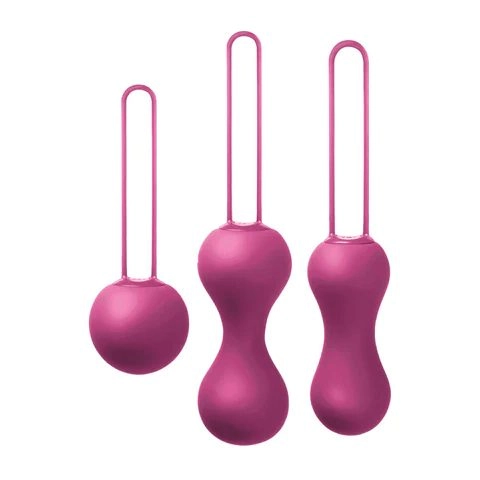
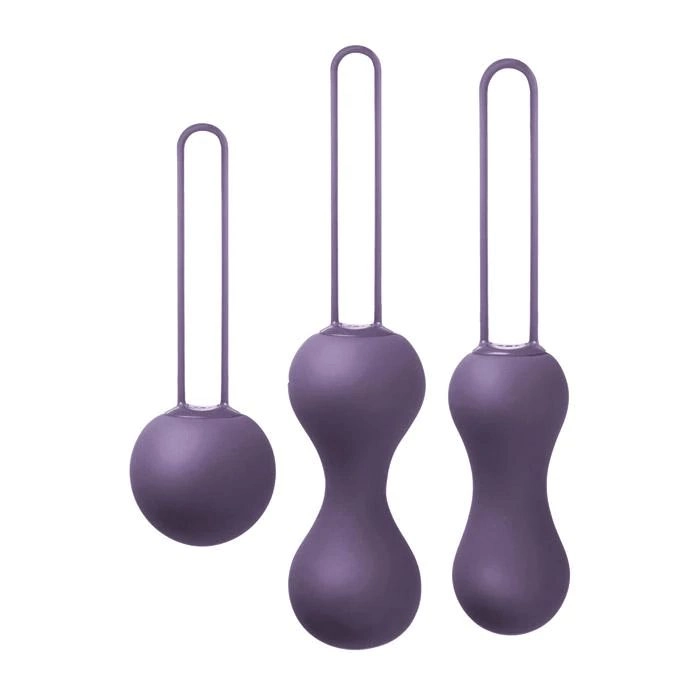
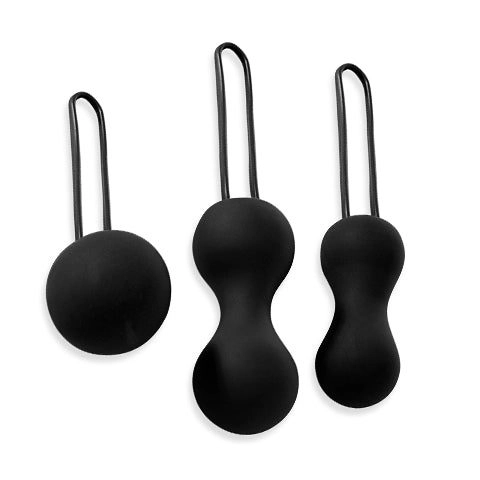
Je Joue’s Ami set makes the progression the product. It ships as three separate weights — 47 g, 78 g and 106 g — so you start at the one you can comfortably hold for fifteen to thirty minutes and move up only once the current weight has stopped being effort. All three colourways — Fuchsia, Purple and Black — are the identical three-stage set. Colour is the only choice you’re actually making between them.
Passive weight versus electrical stimulation
Every kegel-ball product does one of two things: it sits there and makes your muscles work to hold it, or it actively stimulates the muscle for you.
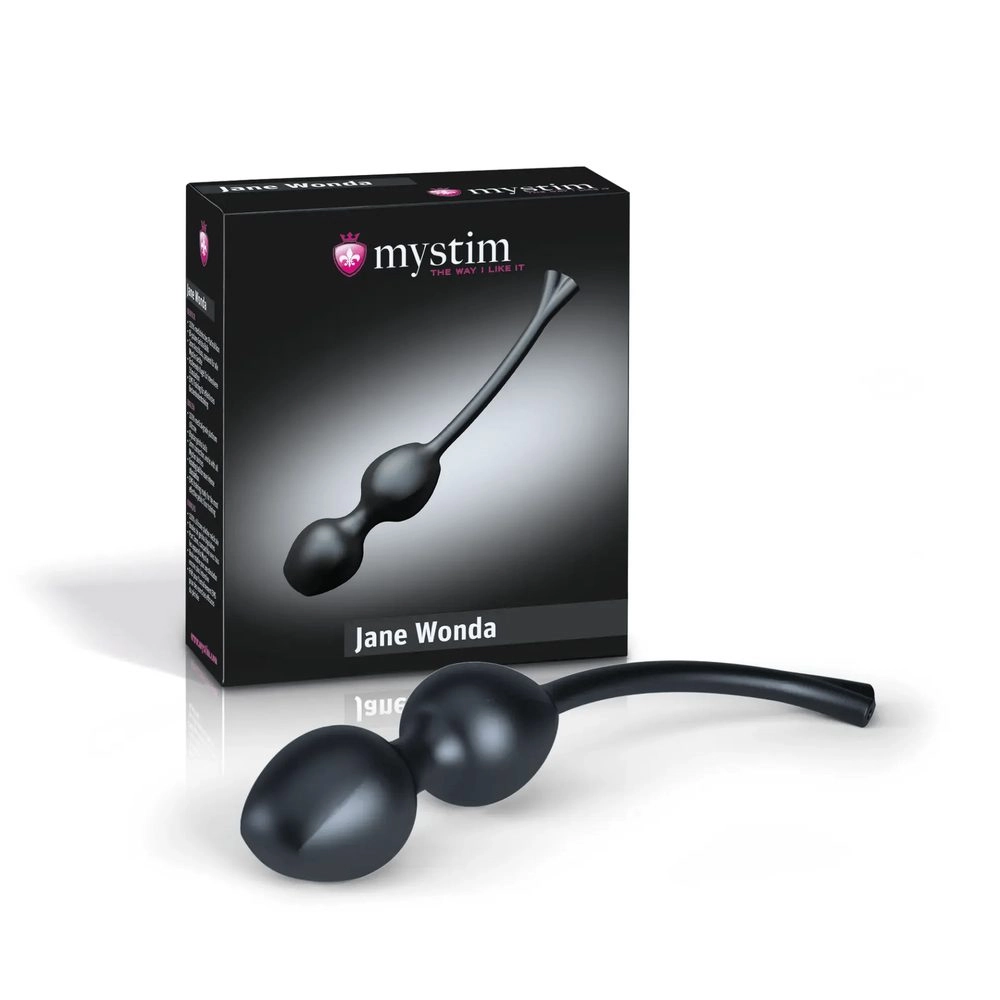
The Ami set is entirely passive — no batteries, no app, nothing to charge. Mystim’s Jane Wonda Geisha Balls Duo works differently: it pairs mechanical weight training with electrical stimulation, run through a separate Mystim Cluster Buster controller that isn’t included and has to be bought alongside it. That’s worth knowing before it goes in your cart — this isn’t a self-contained toy the way the Ami set is. It’s the first piece of a small e-stim system.
Material and shape
All four products here are body-safe silicone, which matters more with an insertable product than almost anywhere else — it doesn’t harbour bacteria the way porous materials can, and it can be washed rather than just rinsed. The Ami set is a single ball at the lightest weight and a double-ball shape at the two heavier stages; Jane Wonda is a double-ball shape throughout.
Retrieval
Every set here uses a retrieval loop or cord rather than relying on a finger — worth checking on anything you’re considering elsewhere. A set with no retrieval method at all is a real design flaw, not a minor one.
Noise, weight, and bedroom confidence
None of this is loud, and none of it needs to be. The passive Ami set makes no sound at all — it’s silicone and gravity, nothing electronic to hum. Jane Wonda is nearly silent mid-session too, which matters if you’re planning to wear it around the house rather than during a dedicated block of time — though anything running through a separate controller is a little less discreet to carry than something entirely self-contained.
How to use it so it feels incredible, not awkward
Start with the lightest weight you have, and start short — fifteen to thirty minutes, not all day. Use a water-based lubricant to insert it; anything silicone-based will slowly break down silicone toys over the same sessions that are supposed to be building you up, so water-based is the only sensible pairing here regardless of what you’d reach for otherwise.
Move to the next weight only once the current one genuinely stops registering as effort — not on a schedule, and not because a box said four weeks. If you’re using the e-stim option, start at the lowest intensity the controller offers and adjust up. There’s no reason to find your ceiling on day one.
The trade-offs: when it’s perfect, and when it is not
This is a good fit if you want a passive, low-effort way to build pelvic floor strength over weeks, and you’d rather it happen while you’re doing something else than carve out gym time for it. The Ami set in particular is close to foolproof — no charging, no app, no controller to lose.
It’s the wrong fit if you’re managing a diagnosed condition rather than general conditioning, or if you’re specifically shopping for a menstrual product — see above on both counts. And Jane Wonda specifically is the wrong first purchase if you don’t already have, or aren’t ready to buy, a compatible Mystim controller. The balls alone don’t do the electrical half of what makes it different.
Care and longevity
Wash before first use and after every session — warm water and a mild soap, or a dedicated toy cleaner, is enough. Silicone is non-porous, so it genuinely gets clean rather than just rinsed. Let it air dry fully before storing, and keep it apart from other silicone items in storage the same way you’d keep it apart from silicone lube — silicone against silicone degrades over time either way.
Finding your fit
Starting out, or returning after a break — Je Joue Ami Kegel Balls, Fuchsia ($79.99). The full three-stage progression in one box; begin at 47 g and don’t rush the next weight.
Prefer a different colourway, same set — Purple or Black ($79.99 each), identical in build to the fuchsia set.
For every session, whichever set you choose — a water-based lubricant for insertion, and a toy cleaner or mild soap for afterward.
Pelvic floor strength isn’t a performance metric, and it was never supposed to be something you either have or don’t. It’s closer to any other kind of consistency — small, unglamorous, and compounding whether or not anyone’s watching. Whichever set you start with, the only real failure mode is starting too heavy and quitting in week one.
Most couples believe they are building intimacy. They spend time together, they share a bed, they know each other’s coffee orders and childhood stories. And yet something essential is missing, a quality of connection they cannot quite name. That gap has a precise explanation.
Emotional intimacy is not a soft, supplementary layer added on top of a “real” relationship. It is the structural foundation that determines whether everything else holds. Without it, physical closeness becomes routine, romantic gestures feel performative, and even years of shared history can coexist with profound loneliness.
This piece takes the concept seriously. You will find a precise definition of emotional intimacy, grounded in research, and a clear account of how it actually develops through two specific mechanisms. You will also see how it differs from physical and romantic intimacy, why most couples bypass it entirely, and why that sequence is exactly backwards.
By the end, you will have a mental model that reframes the way you think about connection, along with a concrete reason to treat emotional intimacy not as a reward for a good relationship, but as its precondition.
Intimacy Meaning: What the Word Actually Tells Us
The word intimacy contains its own definition, if you know where to look. It derives from the Latin intimus, meaning “inmost” or “innermost,” a word Romans used for what lies deepest within a person: feelings, the private self, the life not visible from the outside. The abstract noun intimacy followed from that root in the 1640s, carrying the same orientation inward.
That origin matters because it immediately corrects the way most people use the word today. In common usage, intimacy has become a near-synonym for closeness, affection, physical contact, or simply spending time with someone. These are exterior things, behaviours and conditions that can exist entirely independent of any exchange of inner life. The etymology says otherwise: intimacy, at its root, has nothing to do with what you do with another person. It concerns what you share of yourself and what they share in return.
This is not a semantic footnote. It shifts the entire frame. If intimacy is about the innermost, then physical proximity without genuine self-disclosure is not intimacy at all. Two people can be affectionate, cohabiting, even physically close and still be essentially unknown to each other. They are adjacent, not intimate.
Establishing this at the outset clears away the comfortable assumptions most people carry into conversations about connection. The more precise psychological definition of emotional intimacy builds directly on this foundation, but the etymology does the preparatory work: it locates intimacy where it has always lived, in interior experience rather than outward behaviour.
Emotional Intimacy, Defined with Precision
With the etymology established, the psychological definition gives that root meaning its working architecture.
Psychologists Harry Reis and Phillip Shaver offered the definition most relationship researchers still build on. In their interpersonal process model, intimacy is not a feeling you simply have but a sequence you move through:
Intimacy is an interpersonal process in which one person expresses important self-relevant feelings and information to another, and as a result of the other’s response comes to feel known, validated, and cared for.
Notice where the intimacy actually happens. Not in the disclosure itself, but in what comes back. Three words in that definition carry the most weight.
Known specifies what is being shared: inner life, not surface behaviour. Preferences, habits, and history are not the same as fears, doubts, and desires. The first describes a person; the second reveals them. And being known runs in both directions. One person’s openness in the absence of the other’s creates exposure, not connection.
Validated means the response communicates that what was shared makes sense and is acceptable. This is where intimacy either forms or collapses. Disclosure met with judgment, dismissal, or correction does not produce closeness. It produces wariness.
Cared for means the response carries genuine concern for the person, not just attention to the information. Understanding without warmth is comprehension. Understanding with warmth is what makes someone feel safe enough to share again.
This framework also clarifies what emotional intimacy requires in practice: authentic self-disclosure of both positive and negative emotional content. Sharing joy is the easier half. Sharing hardship, uncertainty, or shame is equally foundational, and often more determining. Intimacy built only on the pleasant is incomplete and fragile under pressure.
Finally, this definition draws a clear line between emotional intimacy and longevity. Two people can share decades, a home, and a routine while remaining largely unknown to each other. Time is a condition. Knowing is a practice.
The Two Mechanisms That Actually Build It
Knowing the definition is not the same as knowing how intimacy forms. The definition tells you what it is; the mechanisms tell you how it gets built.
Emotional intimacy does not accumulate through shared activities, years together, or frequency of contact. What actually produces emotional intimacy is a two-part process, and both parts are required.
The first mechanism is self-disclosure: the deliberate sharing of inner experience, including feelings, fears, desires, and vulnerabilities that are not ordinarily visible. Not small talk. Not logistics. The interior content most people instinctively protect. In a 2025 study of 905 university students in romantic relationships, self-disclosure correlated positively with relationship satisfaction, but the correlation was modest on its own (r = 0.32). Disclosure is necessary, but not sufficient.
The second mechanism is responsiveness: the other person receiving that disclosure with genuine understanding, validation, and care, rather than deflection, judgment, or distraction. In the same study, perceived partner responsiveness, meaning how understood, valued, and cared for people felt by their partner, showed a substantially stronger correlation with relationship satisfaction (r = 0.51). Critically, it partially mediated the link between disclosure and satisfaction: much of the benefit of opening up runs through how that openness is received.
Responsiveness is the less-discussed half of the equation, and often the more demanding one. It requires holding another person’s interior experience without immediately reframing it around your own. That is a different skill than talking.
One-sided disclosure does not produce intimacy; it produces imbalance. Without reciprocal vulnerability, the person sharing is exposed rather than known.
This two-part structure clarifies a useful distinction. Therapy involves one-directional disclosure by design. Performance involves managed, selective sharing. Sympathy offers a caring response without equivalent vulnerability. Emotional intimacy requires all of it: honest disclosure, genuine reception, and mutual exposure.
What Emotional Intimacy Is Not: Clearing Up the Confusion
Knowing how emotional intimacy forms is clarifying. Knowing what it is commonly confused with is equally important, because the confusion is what causes people to neglect the real thing.
Physical intimacy and emotional intimacy are not the same category. Bodily closeness and contact can coexist with deep mutual knowing, or it can exist in its complete absence. The two do not automatically produce each other. A relationship can be physically close and emotionally distant; the reverse is also true. Emotional intimacy works on its own terms, separate from physical contact, with its own conditions and its own failure modes.
Romantic intimacy is broader than emotional intimacy, not synonymous with it. It encompasses emotional, physical, and relational dimensions together. But it depends on the emotional layer as its foundation. Remove that layer, and the romantic category still has visible parts; it simply lacks the architecture that holds them together.
Platonic intimacy is real. Close friendships and non-romantic bonds can reach the same quality of mutual knowing and acceptance as romantic partnerships. The mechanism is identical: self-disclosure met with genuine responsiveness. The relationship category differs; the underlying process does not.
Intimacy synonyms present a quieter problem. Words like closeness, connection, affection, and warmth describe feelings or outcomes. They do not describe the process that produces them. Substituting these words for the precise term makes it harder to notice when the process is absent, because the feelings can persist, briefly, on inertia.
Shared history, cohabitation, and years of experience are enabling conditions, not the thing itself. You can live alongside someone for decades without ever truly knowing them. Proximity permits intimacy; it does not produce it.
That distinction carries a real cost. Loneliness within an otherwise intact relationship is one of the clearest signs that proximity has been mistaken for intimacy, and that the emotional layer has been quietly left unbuilt.
Why Emotional Intimacy Has to Come Before Everything Else
So far, this post has drawn a clear line between emotional intimacy and everything adjacent to it. The question that follows is not just definitional. It is sequential: why does emotional intimacy have to come first?
The conventional assumption treats it as a reward. Build something together, sustain physical closeness long enough, and emotional depth will arrive as a natural result. The opposite is closer to the truth. Emotional intimacy is not what a good relationship produces; it is what a good relationship requires in order to form.
Without a foundation of mutual knowing and acceptance, physical connection remains genuinely pleasurable but does not compound. It satisfies in the short term while leaving something harder to name unmet. That gap tends to widen quietly over time.
A satisfying intimate relationship can ease loneliness, soften stress, and steady a person’s sense of well-being. The operative word is satisfying, and satisfaction at that level requires the emotional layer to be present and active. Physical closeness without it can exist inside the same space as profound loneliness.
Emotional intimacy is also what makes physical connection feel safe enough to be honest, curious, and unhurried. Without it, vulnerability in any dimension of a relationship carries risk rather than invitation. People manage their exposure rather than offering it.
Couples who prioritize emotional connection have a named foundation to return to when conditions become difficult, the shared knowing that gives conflict and change somewhere to land.
The architecture metaphor holds precisely because it is not romantic. You can inhabit a structure without a foundation. For a while, it functions. Under pressure, it does not.
Why Most Couples Skip the Foundation
Knowing the foundation matters is one thing. Understanding why so many people never build it is another.
Fear of rejection sits at the centre of it. Genuine self-disclosure means exposing the parts of yourself you are least confident will be accepted. Most people have spent years learning to manage that exposure carefully, and that conditioning does not dissolve because a relationship is serious or long-standing. The risk feels real because, at some level, it is.
Modern life compounds the problem through sheer pace. Emotional intimacy requires slow, unhurried time. It does not develop during grocery runs, calendar coordination, or the fifteen minutes between one obligation and the next. The rhythm of contemporary life crowds out the conditions intimacy needs, not through malice but through relentless scheduling.
Surface-level communication becomes a trap of its own making. The longer two people speak primarily in logistics, the more unfamiliar and risky it feels to shift toward interior experience. The pattern is self-reinforcing: avoidance makes depth feel stranger, which makes avoidance feel safer. This is one of the quieter ways relationships drift without either person deciding to let them.
Some people fear being known entirely. There is a concern, not always conscious, that being fully understood by another person means being reshaped by them, or losing the edges that define who you are. Strategic self-protection can persist even within relationships that are otherwise close.
Unrealistic expectations also obstruct. Many people wait for a significant, unmistakable moment of connection rather than recognising that emotional intimacy accumulates through small, repeated acts of disclosure and attentive response.
The cumulative result is predictable: relationships that are functional, affectionate, even physically close, while the emotional foundation remains largely unbuilt.
Emotional Intimacy as an Intentional Act
Naming the barriers is useful. Deciding to work against them is the actual move.
Emotional intimacy does not accumulate by accident. Most people sense this but rarely act on it: disclosure and responsiveness are learnable behaviours, and recognizing them as the operative mechanisms is what makes deliberate practice possible. You stop waiting for closeness to arrive and start building the conditions it requires.
Those conditions are specific. Unhurried time is not incidental; it is structural. Choosing, repeatedly, to move past the logistical register and inward instead is the core act. Neither partner can carry this alone. Mutual willingness is not a given; it is a decision, made more than once.
When physical connection grows from a foundation of emotional knowing, the nature of it changes. The emotional layer does not enhance physical experience as a bonus. It changes the conditions under which it occurs.
Rituals and objects that slow the pace and invite presence can serve as practical scaffolding for this work. Not because they create intimacy, but because they create the circumstances in which intimacy becomes more likely. The distinction matters. Nothing external produces mutual knowing; it can only make room for it.
Finally: emotional intimacy is not a state you arrive at and maintain passively. Deep connection is sustained by continuing to disclose over the years, not by levelling off once closeness feels established. The practice does not end. Relationships that understand this treat attention as ongoing, not established.
The Foundation Is the Work
Treating emotional connection as a practice, rather than a background condition, is where the work becomes concrete.
The core argument of this piece reduces to one claim: emotional intimacy is not preliminary to a real relationship. It is the relationship’s structural condition. Physical closeness, sustained desire, and the capacity to move through conflict all rest on whether two people genuinely know and accept each other at the level of inner life.
The question worth carrying forward is not which technique to try next. It is simpler and more demanding than that: Am I actually known by this person? Do I actually know them?
If the honest answer is incomplete, that is not a verdict. It is a direction. Emotional intimacy is available to any relationship willing to slow down, pay genuine attention, and tolerate the small exposures that mutual knowing requires. The foundation is not mysterious. It is not reserved for certain kinds of people or certain stages of life. It is built, incrementally, through repeated acts of disclosure and care. That is both the work and the possibility.
Conclusion
The model is simple, even if the practice is not.
So here is your call to action: choose one conversation this week where you move past the practical surface. Share something real. Receive something real in return.
The gap between the relationship you have and the one you want is often smaller than it appears. It closes one honest exchange at a time.
The fumbling part isn’t the sex. It’s the five minutes before, when nobody’s sure if the ring is the right size, whether the base will actually stay put, or whether you’re supposed to figure this out together or one person is quietly expected to have already read the instructions. Get the compatibility question settled ahead of time and that five minutes disappears — what’s left is just the part you were looking forward to.
This guide covers exactly that: how a dildo and a harness actually pair, using the real mechanism our current harnesses and harness-compatible dildos use — not the generic advice you’ll find repeated everywhere else.
What harness compatibility actually means
A lot of what’s written about harness compatibility describes a rigid, interchangeable O-ring system — a hard ring in a fixed size, with a dildo base that has to be wider than that specific ring. That’s one real system, but it isn’t the one used by the harnesses currently stocked here, and it’s worth being precise about the difference before you shop.
Every harness in this store’s current lineup — the Harness Lingerie Idole and Harness Simili Generous among them — uses a discreet, stretchable silicone ring rather than a fixed hard ring. Their own listings describe this ring as compatible with “all SOM dildos” (Strap-on-me, the brand behind most of the harness-compatible dildos here), which means the fit question is less about measuring a base against a fixed ring diameter and more about choosing a dildo built for that stretch-ring system in the first place.
The base still matters
A stretch ring is more forgiving than a rigid one, but it isn’t infinitely forgiving. The Glow-LED Dildo‘s own listing states it directly: “strong suction base, harness compatible” — a base built specifically to seat and stay in a ring like this one. That’s the detail to look for on any dildo you’re considering for harness use: a base explicitly described as suction-style or harness-compatible, not just any dildo with a wide-ish bottom.
Firmness and material
The shaft needs to hold its shape under the sideways pressure of penetrative use, which is different from the pressure a hand-held toy experiences. The Glow-LED Dildo is liquid silicone with a semi-realistic shape; the Sliding Skin Realistic Dildo uses a dual-density construction — a firmer core under a softer outer layer — which is generally the more forgiving choice for harness use because it resists buckling while still feeling soft to a partner.
Insertable length, and what the harness takes off the top
The Glow-LED Dildo publishes 164 mm insertable, with a glans diameter of 35 mm and a shaft diameter of 33 mm — genuinely specific numbers, which is rare in this category. The Sliding Skin Realistic Dildo, in its M size, publishes 13.4 cm insertable at an 18 cm total length and 3.8 cm diameter; the L and XL sizes go larger but the store’s own listings for those sizes don’t repeat the same measurement breakdown, so if precise sizing matters to you, the M size is the one with numbers to check against rather than a guess. In a harness, actual effective depth runs slightly shorter than the toy’s stated insertable length, since the base sits against the wearer’s body and the harness fabric itself takes up a small amount of that distance.
Harness fit: sized or one-size-stretch
The harnesses here split into two fit approaches. The Harness Lingerie Idole is sized XS through XL with a defined waist cut, which tends to sit more securely for a specific body. The Harness Simili Generous is one-size-fits-XS-to-XXL with adjustable straps at the waist and legs — more forgiving if you’re buying for a partner whose size you’re not certain of, or if the harness will be shared between more than one body.
Comfort, confidence, and what to expect the first time
Neither the harness nor a non-vibrating dildo makes noise, so discretion isn’t the concern here that it is with a motorized toy — the concern is fit. A harness that’s genuinely comfortable disappears from your attention within a few minutes; one that’s the wrong size announces itself the whole time, through chafing at the leg straps or a waistband that rides up mid-use. Try the harness on alone first, adjusted and walked around in, before it’s ever part of a session with someone else — getting the fit right is not a task to solve in the moment.
How to use it so the first session feels good, not like a setup project
Choose the dildo before the session, not during it. Confirm it’s described as harness-compatible — the Glow-LED Dildo’s “strong suction base” language is exactly what to look for — and if this is a partner’s first time receiving from harness penetration, size down slightly from what you’d choose for solo use; the different angle and the absence of the wearer’s own physical feedback make a smaller size more forgiving to start.
Fit and adjust the harness on its own, empty, before the dildo goes anywhere near it. Walk around in it. Make sure the leg and waist straps sit snugly without digging in. This takes a few minutes and is genuinely hard to do well in the moment once a session has started — do it ahead of time and you won’t have to think about it again.
Seat the dildo’s base fully against the stretch ring from the front, so the base sits flush and the shaft points outward. If it doesn’t sit snugly — if it can be pushed backward through the ring without real resistance — the base isn’t a good match for that ring and a different dildo is the fix, not more force.
Talk about angle and depth before you begin, not mid-session. The angle of penetration from a harness is different from other penetration, and it’s different for every combination of bodies and harness position — the receiving partner is the one with the information about what’s working, so build in a habit of them directing early adjustments. The conversation before the conversation covers this kind of check-in as its own skill, worth reading if talking through what you want out loud doesn’t come naturally yet.
Use more water-based lubricant than feels necessary, and reapply during the session rather than treating it as an interruption. There’s no natural lubrication involved in harness use the way there is in some other kinds of penetration, and the friction profile is genuinely different — this is the single detail that separates a session that flows from one that feels like work.
The trade-offs: when it’s perfect, and when it is not
A stretch-ring harness and a compatible dildo are right for you if you want hands-free penetration without committing to a single fixed-ring hardware system, and you’re comfortable with a bit of upfront fitting before the first session. It is wrong for you if you already own dildos designed for a rigid O-ring system elsewhere — those bases won’t necessarily seat the same way in a stretch ring, and mixing systems is exactly the kind of assumption this guide is trying to save you from making.
It’s also worth being honest that harness use has a real learning curve the first two or three times — angle, depth, and pacing all take some finding. That’s not a flaw in the products; it’s true of the category generally, and it gets meaningfully easier once the fit questions are off the table.
Care and longevity
Clean the silicone dildo with a dedicated toy cleaner and warm water after every use, and let it dry fully before storing — the Sliding Skin and Glow-LED dildos are both listed as fully waterproof, so a thorough rinse is straightforward. Harness fabric — microfiber, leatherette, or lace depending on the style — should be spot-cleaned or hand-washed per the specific product’s care notes rather than machine washed by default, since the stretch ring hardware and any metal snaps can be damaged by a washing machine cycle.
Finding your fit
Harness Lingerie Idole · $94.99 — sized XS–XL, high-waist cut, stretch silicone ring compatible with all SOM dildos. The most secure fit for a known body.
Harness Simili Generous · $119.99 — one-size XS–XXL with adjustable straps and a snap-button ring; the more forgiving choice if sizing is uncertain.
Glow-LED Dildo · $119.99 — 164 mm insertable, explicitly listed as harness-compatible with a strong suction base. The specced, low-risk pairing to start with.
Sliding Skin Realistic Dildo (M) · $104.99 — dual-density silicone, 13.4 cm insertable, a softer-feeling realistic alternative in the SOM-compatible line.
Browse the full strap-on dildos and harnesses collection to compare the rest of the lineup, or the harnesses on their own if you’re building a collection of interchangeable dildos around one harness.
The compatibility question isn’t as complicated as it looks — it’s a suction-style base seated in a stretch ring, not a measuring exercise with a rigid one.
Get that part settled before the first session, and what’s left is the part you were actually looking forward to.
Finding intimate wellness products that actually speak to your experience as a queer person can feel like searching for something that was never meant for you in the first place. Most guides assume a very specific kind of body, a very specific kind of relationship, and a very specific kind of desire. If that has never been your reality, you already know the frustration.
This guide is different. It was written with LGBTQ+ individuals and couples at the centre, not tucked into a footnote at the end.
Whether you are shopping for yourself, looking for queer gifts with genuine intention, or simply trying to figure out where to even begin, this post will walk you through what actually matters. You will learn what anatomy-inclusive design looks like in practice, how to find harnesses that fit real bodies, which materials are genuinely body-safe, and how to shop with confidence and privacy in Canada.
You will also find honest guidance for first-time buyers and ideas for couples who want to deepen connection intentionally. No clinical jargon, no assumptions, and no heteronormative defaults. Just clear, practical information written for you.
The Gap No One Is Filling
If you’ve ever searched for queer intimate wellness guidance and landed somewhere that felt like it was written for someone else entirely, that’s not a gap in your knowledge. That’s a gap in the market.
Most intimate wellness resources are built around a default: two people, cisgender, heterosexual, with bodies and relationships that fit a very specific mould. LGBTQ+ buyers show up to those resources as an edge case, addressed in a side note or a single tokenizing paragraph, rather than as the primary audience the content was actually designed to serve.
The two dominant alternatives don’t fill the gap so much as deepen it. Clinical sex-ed content reaches for safety through medicalized language that feels more like a waiting room pamphlet than a conversation. It informs without welcoming. Adult-entertainment retail swings the other way, framing intimacy as performance, spectacle, and novelty, which misrepresents what most queer wellness buyers are genuinely looking for. Neither space was built around self-knowledge, connection, or the kind of unhurried self-care that actually serves people well.
The need for something different isn’t abstract right now. Statistics Canada data released in August 2026 documents a measurable decline in acceptance of gender diversity across the country, with support dropping roughly 8 percentage points among both women and men since 2018. Some provincial declines were steeper. The social climate that shapes how safe it feels to walk into a shop, ask a question, or simply exist visibly as a queer or gender-diverse person has shifted. For many buyers, a discreet, affirming online space is not a preference. It is a practical necessity.
That climate intersects with something observed consistently across LGBTQ+ health contexts: widespread institutional distrust within queer communities. When trust in health systems and public institutions is genuinely fragile, a retail environment that feels clinical or institutional does not feel neutral. It actively reinforces the distance.
What’s missing is a third space. Not clinical, not entertainment-oriented; a place where intimate wellness is treated as intentional self-care, and where queer buyers are the intended audience from the first sentence forward. That’s the position XtasyXperience is built around: curated, considered, and designed for people who deserve guidance written directly to them rather than quietly amended to include them.
The rest of this guide covers the practical decisions that follow from that premise.
What Anatomy-Inclusive Design Actually Means
Most intimate products are designed around a default body. That default is cisgender, heterosexual, and narrowly proportioned. Everything else, including trans bodies, non-binary embodiment, and the full range of human anatomy, gets retrofitted after the fact, if it’s considered at all.
Anatomy-inclusive design starts by asking a different question. Rather than “does this body fit the product,” it asks “what does this body need, and how can this product meet it?” That shift changes everything downstream: dimensions, ergonomics, stimulation placement, and the language used to describe all of the above.
What to Look For in a Product Listing
When evaluating a product, four design signals are worth checking specifically:
Adjustable sizing and fit. Products with adjustable components, whether that’s a flexible form, variable depth, or modular construction, accommodate a wider range of bodies without asking the buyer to adapt.
Symmetrical or neutral form factors. A shape designed around one specific anatomy tends to fail every other. Products with neutral geometry are more likely to work across varied bodies, not because they’re compromise designs, but because they weren’t built around exclusion.
Body-neutral description language. Product listings that describe stimulation placement in terms of body regions rather than gendered anatomy are a meaningful signal. It’s a small editorial choice that reflects a larger design philosophy.
Honest sizing information. Insertion depth, width, and reach should be listed in actual measurements, not vague descriptors like “standard” or “natural.”
Reading the Gaps
Trans and non-binary buyers face a particular burden: evaluating whether a product’s stated dimensions actually correspond to their anatomy. If a listing doesn’t provide enough information to make that assessment, that’s not a neutral omission. It’s a signal that the product was designed without queer embodiment in mind.
The absence of anatomy-inclusive language is itself useful data. A listing that relies entirely on gendered framing, or that describes a product as designed “for women” or “for men” without any body-specific detail, tells you that the designer’s starting assumptions excluded a significant portion of potential buyers.
The Editorial Framing Distinction
The clearest difference between curated wellness retail and conventional adult retail is how products are described. Wellness-oriented listings explain what a product does and how it interacts with the body. Conventional listings describe who a product is supposedly for.
One approach gives you the information needed to make a genuine decision. The other assumes you already fit the intended category. If you’re browsing and the language keeps assuming things about you, that’s worth taking seriously.
Harness Fit and Strap-On Considerations for Every Body
Harness fit takes the question what does this body need and makes it structural. It is one of the most body-specific purchases in the intimate wellness category and one of the least well-explained in standard buying guides.
Here is what actually matters before you buy.
Measurements First
Start with two numbers: hip circumference and waist circumference. Most harnesses specify a fit range in both, and they are not interchangeable. A harness that fits your hips may sit awkwardly at the waist, or vice versa. Measure both before consulting sizing charts, and look for harnesses that list actual centimetre or inch ranges rather than vague S/M/L designations. If a retailer does not publish those numbers, that tells you something.
Adjustability matters across the full size range. A harness with multiple adjustment points, rather than a single buckle, tends to distribute fit more evenly and accommodate a wider range of body shapes.
O-Ring: Fixed or Interchangeable
This single feature has more long-term impact than any other. A fixed O-ring locks you into one toy diameter. An interchangeable O-ring, typically sold as a set of two or three sizes, means the harness works with different toys as your preferences evolve. An interchangeable system turns a harness into a durable investment; a fixed ring makes it a one-pairing purchase.
Check the listed diameter range before buying a toy and harness separately. They need to be sized for each other.
Thigh Harnesses
For buyers with mobility considerations, post-surgical anatomy, or specific preferences around how weight and movement are distributed, thigh harnesses offer a genuinely different fit logic. They sit on the thigh rather than the hips, changing both the mechanics and the experience. They are not a workaround; they are a distinct and valid option that conventional buying guides rarely mention.
Material and Maintenance
Leather harnesses are durable, conform to the body over time, and hold their shape well, but require conditioning and cannot be machine-washed. Fabric and neoprene harnesses are more size-flexible, easier to clean, and more accessible in price. The right material depends on how you plan to use and care for it.
Packing vs. Penetrative: Different Products
These two harness types are built and fit differently. A packing harness holds a soft form securely against the body throughout daily wear; comfort, discretion, and stability are the priorities. A penetrative harness is built for security during use, with different stress points and construction requirements. Buying the wrong type is not a sizing problem you can adjust your way out of.
A retailer that publishes honest measurement guides, lists actual size ranges, and describes harness type and O-ring specs clearly is one that built its curation around queer buyers. That transparency is worth paying attention to.
Body-Safe Materials: What the Labels Don’t Always Tell You
Fit and material quality belong together. Once you have assessed how a harness or product works with your body, the next question is what it is made of, and in Canada, that question has fewer guardrails than most buyers expect.
“Body-safe” is an unregulated phrase under the Canada Consumer Product Safety Act, no federal certification standard governs it for intimate products. When a label says body-safe, it means the brand believes it, not that anyone has verified it. Buyers need their own framework.
The materials that hold up
Four materials are consistently cited by sexual health educators as preferable for intimate use:
Medical-grade silicone: Non-porous, easy to clean, free of known irritants, and available in a range of firmness levels. The gold standard for good reason.
Borosilicate glass: Non-porous, temperature-stable, and completely inert. Only borosilicate; standard glass is not equivalent.
Stainless steel: Non-porous, heavy, and long-lasting. Often used in smaller products where weight and firmness are appropriate.
ABS plastic: Hard, non-porous, and commonly used in external components and toy housings. Reliable when the full product is ABS rather than a blend.
What these share: they do not absorb bacteria, they can be cleaned thoroughly, and their composition is stable over time.
What porous materials actually mean
Sex health educators commonly advise that jelly rubber, many TPE blends, and vaguely labelled “skin-safe” or “realistic feel” compounds are porous, meaning microscopic channels in the material retain bacteria even after washing. A condom or barrier reduces but does not eliminate the risk. If a product listing does not name a specific material, treat that omission as a signal. Vague language usually reflects a vague product.
Fragrance, colour, and hidden irritants
Scent additives and synthetic colorants in intimate products are an underreported concern. For buyers with skin sensitivities, these additives may be worth avoiding as a precaution, particularly during hormonal transition or post-surgical healing when tissue sensitivity can vary. Unscented products in neutral or single-tone colorways are the lower-risk default, not just an aesthetic preference.
This matters more, not less, for bodies undergoing hormonal transition or post-surgical healing. Heightened tissue sensitivity means material quality becomes more consequential at exactly the moment when product descriptions rarely account for it.
What a trustworthy listing looks like
A retailer serious about material safety names specifics: the grade of silicone, whether glass is borosilicate, whether any component contains phthalates or latex. If a listing only says body-safe without naming what the product is made of, the information you need to evaluate it simply is not there.
Shopping With Confidence: Discretion, Privacy, and What to Expect
Knowing what a product is made of matters. So does knowing whether your purchase will arrive safely, appear neutrally on a bank statement, and reach you without anyone else being the wiser.
Queer Canadians experience what many know firsthand: fear of stigma and deep institutional distrust are primary barriers to engaging with health systems. That wariness doesn’t evaporate at checkout. A retailer that takes queer buyers seriously acknowledges this directly, not in fine print.
What discreet shipping actually means. Reputable Canadian intimate wellness retailers ship in plain, unmarked packaging with no identifying product description on the exterior. Billing appears under a neutral company name, not a store name that announces the purchase. If a retailer’s website doesn’t state this clearly, ask before you order. Vagueness here is not reassuring.
Why privacy is more than convenience. The acceptance decline documented in the opening section makes this more than a convenience. For many LGBTQ+ shoppers, the ability to browse and buy without visibility isn’t a preference; it’s a practical layer of safety. Online shopping, done through a retailer that handles discretion properly, removes exposure that in-person retail cannot.
How to read a retailer’s values before you buy. As noted earlier, a retailer’s editorial content is the clearest signal of whether the brand was built for buyers like you. Read the articles section before you read the product listings. The questions a brand chooses to answer tell you more than any product description.
XtasyXperience is a Canadian intimate wellness retailer built around exactly this kind of intentional curation. Check the shipping and privacy policy pages for packaging and billing details. The editorial section exists specifically to answer the questions most buyers have before they’re ready to ask them, so that by the time you reach checkout, you’re deciding with confidence rather than hoping for the best.
Queer Gifts and Gift-Giving With Intention
Buying for someone you care about in this category takes a different kind of attention than most gift guides prepare you for. The majority of mainstream “wellness gift” round-ups are built around heteronormative assumptions: gendered packaging, bodies described in narrow terms, and product language that quietly tells certain readers they weren’t considered. That makes them unreliable starting points when you’re looking for queer gifts, gifts for queer friends, or anything meant to honour someone’s actual embodiment rather than a demographic assumption about it.
What makes a gift work here isn’t category knowledge. It’s the right criteria.
The safest choices in intimate wellness share four qualities:
Body-positive framing that doesn’t anchor the product to a specific anatomy
Adjustable or body-neutral design that fits the recipient rather than requiring the recipient to fit the product
Premium materials with no hidden irritants, particularly medical-grade silicone or other non-porous options discussed earlier in this guide
Packaging that doesn’t assume gender, relationship structure, or anything else about who is opening it
Concrete starting points for thoughtful, unique gifts in Canada include a high-quality personal massager in medical-grade silicone, such as the Le Wand Die Cast Rechargeable Vibrating Massager at $229.99, versatile, body-neutral, and immediately useful. A curated set that pairs sensory and intimate care pieces, such as the Le Wand All That Glimmers set at $184.99, gives a gift some texture beyond a single item. And a body-safe lubricant formulated for sensitive tissue, such as simply® Timeless Silicone at $69.99, is built for a reality — hormonal transition, post-surgical healing, ordinary sensitivity — that most gift guides never account for. Each of these signals care without making anatomical assumptions about the person receiving it.
One principle covers every label: choose by function, not by who a product is supposedly “for.”
Whether you’re buying queer gifts for her, for him, or for someone who uses neither pronoun, the same logic applies. A product described by what it does and how it interacts with the body is inherently more inclusive than one marketed to a presumed user. That distinction is easy to spot once you’re looking for it, and it immediately separates retailers worth trusting from those that haven’t thought it through.
The retailer you choose is part of the gift. Shopping somewhere that takes your recipient seriously, uses considered language, and curates with intention communicates something on its own. It says you did more than pick something off a generic list.
For gift-buyers who aren’t sure where to start, a curated editorial guide is more useful than an unsorted product catalogue. Look for retailers whose gift guidance is substantive, not decorative; genuine recommendations, not just a gift-wrap option added at checkout as an afterthought.
For Established Couples: Deepening Connection Intentionally
Gift-giving calls for a kind of attentiveness that established couples know well. But here is something worth naming plainly: almost no research exists on how long-term queer couples actively invest in relational intimacy. A 30-year scoping review of LGBTQ+ aging research in Canada found that peer-reviewed literature concentrated almost entirely on risk, HIV, stigma, and healthcare barriers. Relational wellness, intentional intimacy, sexual self-care for couples in their 30s, 40s, and 50s: essentially absent.
That gap is not an accident. It reflects how queer health has historically been framed, through deficits and crises rather than flourishing. Established couples navigating their intimacy privately and intentionally are, in a quiet but real way, writing a different story.
The process matters as much as the product.
For couples who have been together for years, the point of exploring intimate wellness together is rarely novelty for its own sake. It is shared attentiveness: deciding to pay deliberate attention to something that often gets deferred. Choosing a product together, talking through what each person is curious about, what feels comfortable, what anatomical considerations apply and what pace feels right; that conversation is part of the practice, not just a step before it.
Communication before a purchase does meaningful work. It surfaces assumptions, clarifies preferences, and turns a shopping decision into a shared act of care. The product that comes after that conversation will land differently than one chosen alone and presented as a fait accompli.
What to look for in products for established couples.
Versatility and quality outperform specialisation here. A well-made product in a body-safe material that either partner can use comfortably builds shared confidence in the category. Highly specialised items can be the right choice eventually, but for couples entering or re-entering this space together, a body-neutral, high-quality product in a trusted material is a better foundation than something designed for a narrow use case.
The Le Wand Die Cast Plug-In Vibrating Massager is a fitting example: body-safe silicone and aluminium alloy, corded for unlimited use time so there’s no clock running on exploration, and simple enough that either partner can pick it up without a learning curve. At $219.99, it’s a considered middle ground between a first purchase and something more specialized.
The same body-neutral framing described in the design section applies here.
Where curation helps.
XtasyXperience’s editorial model is built for exactly this kind of considered browsing. Fewer products, described honestly, with context that helps two people make a decision together rather than one person navigating a large catalogue alone. If you are going to have a conversation before you purchase, it helps to have something worth reading together first.
First-Time Buyers: An Honest Guide to Where to Start
If couples benefit from choosing products together, solo buyers deserve the same quality of entry point: something low-stakes, clearly described, and backed by a retailer whose content answers your questions before you think to ask them.
Start with one product, not a category. The goal of a first purchase is orientation, not optimization. A single personal massager in medical-grade silicone is one of the most practical starting points available because it is body-neutral, works across a wide range of anatomies, and does not require familiarity with more specialized product types to use well. It is also a material with a strong safety record: non-porous, easy to clean, and free of the irritants found in lower-grade compounds.
The Le Wand Dive is a straightforward example of what that looks like in practice: a single body-safe silicone and ABS wand, priced at $169.99, waterproof enough for the shower, and versatile enough for solo or partnered use. Nothing else to learn first.
Prioritize in this order:
Body-safe materials over novelty. An interesting shape in an unknown material is a worse purchase than a simple design in medical-grade silicone or borosilicate glass.
One product over a set. Sets look like value; they are usually complexity. Start with something singular.
Honest return or exchange guidance over the lowest price. A retailer with clear policies signals confidence in what they sell.
The discomfort you may feel is not about you. Many first-time buyers, especially in communities with well-founded reasons to distrust institutions, carry a layer of shame into this category. That feeling is a residue of how the category has been framed, in entertainment-oriented retail, in clinical silence, in the general cultural habit of treating queer wellness as a footnote. It is not a signal that the purchase is wrong. Affirming, non-performative retail language genuinely changes that experience; the tone of a brand is not decoration.
As noted earlier, a retailer’s editorial content is the clearest signal of whether the brand was built for buyers like you.
The first purchase is the hardest one. Not because the decision is complicated, but because unfamiliarity amplifies uncertainty. The actual goal is modest: build enough comfort with the category that the second purchase feels easy. That is a reachable bar, and it is the only one that matters on the first try.
Where to Go From Here
Once you have the framework, the next step is simply using it.
This entire guide has been built around one premise: LGBTQ+ buyers in Canada deserve intimate wellness resources designed with them in mind from the start, not adapted from heteronormative templates or pulled from spaces that frame intimacy as performance. That gap is real, documented, and worth naming clearly.
The practical tools are here if you need them. Anatomy-inclusive design tells you what to look for in product descriptions. Harness fit guides walk you through measurement and O-ring compatibility before you buy. Body-safe material standards give you a framework for evaluating claims that no Canadian regulation currently enforces. Gift-giving guidance helps you choose with intention rather than assumption. And whether you are an established couple or a first-time buyer, the same principle applies throughout: start with what you actually need, not with what the category defaults to.
XtasyXperience is a Canadian intimate wellness retailer built around exactly this kind of intentional curation. Products are chosen with queer bodies and relationships in mind. Editorial content is written to answer the questions queer buyers genuinely have. Check the shipping and privacy policy pages for packaging and billing details.
If you are not sure where to start, the Articles section is a low-pressure place to orient yourself. No assumptions, no performance framing, no pressure to buy before you are ready.
Your wellbeing is worth being deliberate about. Browse when you are ready, start with the editorial content if you prefer, and take the time this decision deserves.
Conclusion
Queer intimate wellness in Canada has a real gap, and navigating it takes more than good intentions. This guide covered the foundations: what anatomy-inclusive design actually looks like in practice, how to evaluate body-safe materials beyond marketing claims, and how to shop with genuine privacy protections in place. It also addressed the relational side, from gifting with care to deepening connection in established partnerships.
The throughline is consistent. Start with your actual needs, not the category defaults. Ask better questions of product descriptions, harness sizing guides, and retailer policies. Expect more from the spaces you shop in.
Your wellbeing deserves a deliberate approach, and the right starting point is simply starting.
You unbox it, turn it on, and the first thing you notice isn’t the power. It’s the sound — or the lack of it. A cheap wand announces itself the second it starts; a well-made one hums low enough that you forget anyone else could hear it through a door. That difference, more than anything printed on the box, is where “luxury” actually starts.
Wand vibrators are one of the most crowded shelves in the vibrators category, and most of what separates a $40 wand from a $170 one is invisible until you’ve used both. This is a luxury wand vibrator review built on the numbers three current, in-stock models actually publish — not on adjectives.
What “luxury” actually means in a wand
It doesn’t mean a nicer box. It means the motor produces a deeper, rumblier vibration instead of a buzzy surface one, the silicone finish stays smooth instead of tacky after a few months, and the noise the motor makes is something the manufacturer was willing to measure and print.
That last part is rarer than it should be. Of the three wands in this guide, only one publishes an actual decibel figure: the Le Wand Dive is rated at ≤68 dB at max power — roughly the volume of a running dishwasher, from a device most people run for a few minutes at a time. Prowand and the Le Wand Petite don’t publish a noise figure at all, which isn’t necessarily a strike against them, but it does mean you’re taking the manufacturer’s silence on faith rather than a number.
Why this is its own category
A wand isn’t a rabbit or a bullet with more power behind it. The flat, broad head is built to spread vibration across a wide area rather than concentrate it, which is why wands are the category most people reach for when they want external, buildable stimulation rather than a targeted internal one.
And it depends, which is worth saying plainly: if what you actually want is internal, targeted stimulation, a wand is the wrong tool no matter how well it’s made — a g-spot vibrator or a thrusting vibrator does that job; a wand doesn’t do it at all. If you want something smaller and more precise for solo clitoral play, a dedicated clitoral vibrator will outperform a wand’s broad head on precision every time. A wand earns its place for broad, diffuse, buildable sensation — and for a lot of people, that’s exactly the sensation they’re after.
What to look for in a luxury wand vibrator
Once you’ve decided a wand is the right shape, the real question is which specific design choices actually change how it feels — because “luxury” gets printed on packaging regardless of whether the product backs it up.
Size: full-size power or a petite that travels
The Le Wand Dive is the full-size option, built for the strongest, deepest vibration in the lineup and for two-handed or partner use. The Le Wand Petite, sold currently as the All That Glimmers special edition, measures 254×47 mm with a 43.5 mm head diameter — small enough to travel discreetly and to reach the nipples, neck, or anywhere else a full-size wand is too much tool. Neither is the “better” one. It’s a genuine trade-off between raw output and portability.
Motor character: how many speeds and patterns, and whether that matters
The Le Wand Dive runs 10 speeds and 20 patterns; the Le Wand Petite runs 10 speeds and 6 patterns. More patterns sounds like more value, but most people who own a wand for more than a month settle on one or two steady settings and stop touring the menu. What the speed count actually buys you is finer control over intensity while you’re warming up — which matters more than the pattern count in practice.
Control interface: buttons or an app
Both Le Wand models use a simple three-button interface on the body. The Prowand takes a different approach: it pairs with the FeelConnect app for remote-controlled vibration and pattern changes, and adds a multi-colour LED spotlight that syncs to the vibration. That’s a genuinely different use case — a partner controlling the toy from across the room, or across a distance — rather than a straightforward upgrade. If you don’t want your phone anywhere near the moment, the button interface is the less complicated choice, and Prowand’s own weight (177 g) makes it the lightest of the three, which is worth knowing if hand fatigue during longer sessions is a concern.
Waterproofing and charging
Here the Le Wand Dive is the clear standout on paper: it’s rated IPX8, meaning full submersion rather than just splash resistance, runs off a 2200mAh battery, charges in under 3 hours, and holds roughly 2 hours of continuous use on a full charge. The Petite is described as shower-friendly but doesn’t publish an IPX rating or a runtime figure, and neither does Prowand. If bath or shower use is a real part of how you’ll use this, the Dive is the only one of the three that has actually committed a number to that claim.
Noise, weight, and bedroom confidence
A wand is never going to be silent — the motor has to move enough mass to produce the deep vibration people buy this category for. What varies is whether that sound reads as a low hum or a mechanical whine, and the Le Wand Dive’s published ≤68 dB figure is the only hard data point among these three; treat it as a proxy for build quality even for the models that don’t publish their own number. Weight matters too: at 440 g, the Dive has real heft for longer sessions, while Prowand’s 177 g and the Petite’s compact frame are easier to hold one-handed without wrist fatigue.
How to use it so it feels incredible, not awkward
Start on the lowest setting with the head resting against the outer, less sensitive areas first — the inner thigh or the mons — before moving to direct clitoral contact. Broad, flat heads are more forgiving than people expect, but going straight to a high setting on direct contact is the single most common reason first-time wand users decide it’s “too much.”
For partner use, let the receiving partner hold or guide the wand themselves for at least the first few sessions. A wand pressed too firmly by someone else’s hand can feel completely different from the same setting under your own control, and that mismatch is often mistaken for the toy being wrong rather than the pressure being wrong. A water-based lubricant reduces drag against the silicone head and makes lower settings feel more effective, which is often the better fix than simply turning the intensity up.
The trade-offs: when it’s perfect, and when it is not
A full-size luxury wand like the Le Wand Dive is right for you if you want the strongest, most dependable external stimulation available in this category and don’t mind a device with real heft. It is wrong for you if discretion or portability matters — it is not a toy you casually pack for a weekend away.
A petite wand is right for you if you want that same broad-head sensation in a size that travels and works on smaller, more sensitive areas. It is wrong for you if you specifically want the deepest, most powerful vibration the category offers — smaller motors trade some depth for their size.
An app-connected wand like Prowand is right for you if remote or partner-directed control is part of what you want from the toy. It is wrong for you if you’d rather not have a phone app involved in an intimate moment at all, or if you specifically want a published noise and waterproofing rating to shop against.
Care and longevity
Clean the silicone head with a dedicated toy cleaner and warm water after every use, and let it air-dry fully before storing — silicone that’s put away damp is the most common cause of a shortened lifespan in this category. Stick to water-based lubricant on silicone wands; silicone-based lubricant can degrade a silicone toy’s surface over repeated use. Store the wand somewhere it won’t press against other silicone toys in a drawer, which can cause the surfaces to bond slightly over time.
Finding your fit
Le Wand Dive · $169.99 — full-size, IPX8 waterproof, ≤68 dB published, 2-hour runtime. The strongest and most transparent of the three on specs.
Le Wand Petite – All That Glimmers · $184.99 — the compact, travel-friendly option, currently stocked as a special-edition set with extras; if you only want the wand itself, you’re paying for the kit around it too.
Prowand · $104.99 — app-controlled with a synced LED light, lightest of the three at 177 g, and the lowest price point.
Or browse the full personal massagers and luxury vibrators collections to compare against the rest of the category. If you’re still deciding whether a wand is the right shape at all, how to choose a vibrator covers the broader decision before you narrow in on this one.
A luxury wand earns the word by publishing what it does — a decibel figure, a waterproof rating, a runtime — rather than asking you to trust the packaging.
Buy the one whose numbers match how you’ll actually use it, not the one with the most patterns on the box.
Every product on this site was chosen by one person — the founder of XtasyXperience — from a curated catalogue of established, name-brand intimate wellness products. Not an algorithm. Not a supplier pushing volume. A considered decision, made one product at a time.
This page explains how that process works.
Who We Are
XtasyXperience is a Canadian-owned intimate wellness brand. We ship within Canada, in Canadian dollars. Our catalogue is sourced exclusively through a Canadian wholesale partner that works only with reputable, name-brand manufacturers — every product they carry is verified body-safe, and that verification is stated plainly, both on their end and on ours.
We are a small, intentional shop. We are not trying to carry everything — we are trying to carry the right things.
How Products Are Selected
Our wholesale partner handles sourcing and quality assurance. What they don’t handle is editorial judgment — that part is ours.
From their catalogue, every product on this site was hand-selected based on a few consistent questions: Does this fit how our customers actually live? Does it serve wellness, connection, and self-knowledge rather than hype? Can we describe it honestly, in plain language, without exaggeration? Would we feel comfortable recommending it to someone who trusted our taste?
If the answer to any of those is no, it doesn’t make it onto the site — regardless of how well it sells elsewhere.
What Gets Rejected
Most products don’t make the cut. Common reasons:
Doesn’t fit the intent. We serve wellness-minded individuals, established couples deepening intimacy, and considered gift buyers. A product that doesn’t genuinely serve one of those people has no place here, even if it’s perfectly fine on its own merits.
Requires hype to be sold. If the best case for something is that it’s new, trending, or discounted, that’s not a case we find persuasive. Products earn their place through genuine usefulness, not timing.
Can’t be spoken about honestly. If we can’t describe what a product does and why it’s good in calm, considered language — without euphemism or performance framing — it doesn’t belong in an editorial shop.
On Body Safety
Every product on this site is verified body-safe. This isn’t a claim we make loosely — it’s confirmed at the wholesale level and stated plainly in each product listing. For customers searching for body-safe sex toys in Canada, that confirmation is available on every product page, not buried in fine print. If you have a specific question about materials for any product, contact us and we’ll answer it directly.
Returns and Refunds
Our returns and refunds policy is published in full on our Returns & Refunds page. We encourage you to read it before purchasing. If something isn’t right, contact us — we take those conversations seriously.
On Inclusivity
XtasyXperience was built on the belief that intentional intimacy is for everyone. Our catalogue, our editorial voice, and the way we talk about wellness are designed to be genuinely inclusive — across relationship structures, identities, and orientations. Every person who shops here deserves to feel that this shop was made with them in mind, because it was.
On Discretion
Orders ship in plain, unmarked packaging. No brand name on the outside, no indication of contents. This is standard practice for us — not a feature, just the right way to ship in this category.
Why We’re Telling You This
Most shops in this space don’t explain how they make decisions. We think that’s a mistake. Our customers are thoughtful people making considered purchases — often personal ones. They deserve to know who they’re buying from and what that shop stands for.
This is what we stand for. It doesn’t change based on what’s trending.
The moment a gag goes in, a scene changes shape. Speech disappears, and everything else – breath, posture, the small involuntary sounds a body makes – gets louder in its place. That shift is the entire appeal, and it is also exactly why fit and communication matter more here than in almost any other category of gear.
Here’s how the two gag styles actually sold today differ, and the safety habits that make either one feel confident instead of risky.
What a gag actually changes in a scene
A gag doesn’t just quiet someone – it removes the primary channel most couples use to communicate mid-scene. That forces everything else to do more work: agreed hand signals, a dropped object as a stop cue, and much closer attention from whoever is in control. The sensory trade is real too. Some people find that losing speech intensifies focus and surrender; others find it unexpectedly disorienting the first time, even if they were confident going in.
Why this deserves its own decision, not an impulse buy
Gag play sits at the intersection of two different needs – the symbolism of restriction, and the physical reality of breathing through it. A ball gag and an O-ring gag create very different versions of that experience, and the right one depends on jaw comfort, experience level, and what specifically you’re trying to feel.
It also depends on physical readiness, and that is worth saying plainly: if either partner has nasal congestion, allergies, or any illness that makes breathing through the nose uncertain, this is not the night for a gag – not as a mood-killer rule, but as basic scene design. That condition passes; the gag will still be there next week.
What to look for in a bondage gag
The current range here comes down to a choice between fullness and openness – a ball gag fills the mouth, an O-ring gag holds it open – plus the material and hardware that decide how the strap actually wears over time.
Ball gags: fullness and a clean silhouette
The Saffron Ball Gag is the style most people picture first – a silicone ball on a PU-leather strap with a locking buckle and nickel-free metal hardware, adjustable to fit a range of head sizes. Exact ball diameter isn’t a spec most manufacturers publish, including this one, which is worth knowing going in: you’re sizing by strap adjustability and general fit description, not a published millimeter figure, so err toward a listing described as beginner-friendly if this is a first purchase.
O-ring gags: openness and access
The Edge Interchangeable Ring Gag is the more precisely specified of the two: it ships with two stainless-look rings sized 1.5 inches and 2 inches, swappable depending on how much opening you want, and can be worn with either ring alone or both snapped together for more intensity. The strap is 70% polyurethane, 20% zinc alloy, and 10% iron. An O-ring holds the mouth open rather than filling it, which creates a more visually exposed dynamic and dries the mouth out faster – keep water nearby and plan for shorter wear than you would with a ball gag.
Styles this catalogue doesn’t carry yet
Two other styles come up often in searches about gag types – bit gags, which sit between the teeth like a horse bit and are generally gentler on the jaw than a full ball, and inflatable gags, which start small and expand with a pump for a highly adjustable but advanced experience. Neither is currently stocked here. If one of those is specifically what you’re after, this isn’t the place to find it yet; what the current range does cover well is the more fundamental decision most first-time buyers actually face – fullness versus openness – and that choice matters more to a first purchase than which sub-style you start with.
Pairing with sensory play
Removing sight tends to intensify a gag’s effect more than any other addition. A well-made plush blindfold that fully blocks light pairs naturally with either gag style, since both work by narrowing the senses a partner has left to rely on.
Comfort, breathing, and confidence
The rule that overrides every other consideration: the gagged partner must be able to breathe comfortably through the nose for the entire time the gag is worn. Agree on a clear nonverbal stop signal before starting – dropping a held object, a repeated tap, a specific hand motion – and have the partner in control stay close and sober enough to watch for it. Never leave a gagged person alone, even briefly; bondage already reduces freedom of movement, and removing speech on top of that shrinks the margin for error further than most people expect the first time.
How to use one so it feels elevated, not overwhelming
Keep the first session short – a few minutes, not a full scene – so you both learn how the specific gag feels before committing to longer wear. Introduce one new element at a time rather than combining a gag with heavy restraints and sensory deprivation on the same night; that makes it much easier to tell what’s actually working. Check in with your nonverbal signal periodically even if nothing seems wrong, and treat the first few uses as information-gathering rather than a performance either partner needs to get right immediately.
The trade-offs: when each style is right, and when it isn’t
A ball gag is right for you if you want the classic, symbolic fullness and a clean visual without extra hardware. It is wrong for you if you or your partner have jaw tension or a smaller mouth and haven’t tried a beginner-sized option first – a ball that looks modest in a product photo can still feel demanding in practice.
An O-ring gag is right for you if the visual of an open mouth and easier oral access is specifically what you’re after, and you’re prepared for shorter sessions. It is wrong for you if dry mouth or a feeling of exposure is likely to pull you out of the moment rather than into it – that reaction is common and not a sign you’re doing it wrong.
Care and longevity
Silicone ball gags clean easily with mild soap and warm water and carry no taste or smell when properly maintained. Hardware-heavy pieces like the O-ring gag need the buckle, snaps, and rings inspected before every use – retire it if a strap is cracking or a buckle no longer holds securely. Don’t share gag gear between partners without thoroughly sanitizing it first, and let anything with a strap dry fully before storing so it doesn’t develop mildew or a permanent crease.
A gag isn’t really about silence for its own sake. It’s about how much more everything else – breath, trust, the wait for the next touch – comes forward once speech is out of the way.
Choose the style that matches the specific feeling you’re after, agree on your signal before it goes in, and let comfort set the pace rather than compete with it.
A new arrival should feel like more than fresh inventory on a shelf. The most recent wave here is thrusting vibrators and sex machines – more than a dozen of them, added in the first two days of September – and what’s worth noticing isn’t the count. It’s how many of them publish a real stroke length instead of just calling themselves “powerful.”
Here’s what actually changed, with the numbers the manufacturers put on the spec sheet.
What makes this wave different from a routine restock
Most thrusting toys have historically described themselves the same way – “intense,” “deep,” “powerful” – without saying how far the toy actually moves or how fast. The Lovense Gravity Thrusting Dildo is the exception worth flagging first.
Lovense publishes a 3 cm (1.18 in) stroke length at up to 140 strokes per minute for the Gravity. That’s an unusually specific number in a category that rarely gives you one. Most competing thrusting toys, including several in this same batch, publish overall product length and diameter but not stroke length – which means you’re often buying on trust that “thrusting” means the same motion across brands. It doesn’t.
The rest of the batch fills in around that: the Lovense Vulse moves at up to 120 strokes per minute with a 3.35-inch insertable length, and the sex machine side of the wave – covered in full in the sex machines category – adds hardware built for sustained, hands-free sessions rather than handheld ones.
Why this is its own decision, not just a bigger vibrator
A thrusting toy asks something a classic vibrator doesn’t: it wants to lead the rhythm. For someone who wants penetration-led sensation without doing the work of moving a toy themselves, that’s the entire appeal. For someone who prefers to control pace and pressure directly, a fixed stroke pattern can feel like the opposite of intimate, no matter how strong the motor is.
It also depends on what kind of stimulation actually gets you there, and that is worth saying plainly: if your pleasure is primarily external and clitoral, nothing in this wave is the right purchase – a focused clitoral vibrator will do more for you than any thrusting mechanism. This category is specifically for people whose response is internal, or who want blended internal-and-external stimulation in one device.
What to look for in a thrusting vibrator
Once you know penetration-led motion is what you want, the differences between these new arrivals come down to four things: how far and fast it actually moves, whether the motion is thrusting-only or blended with vibration, whether it can run hands-free, and whether it’s built for one person or two.
Stroke length and speed
The Gravity’s 3 cm stroke at up to 140 strokes per minute reads as short and fast – closer to a rapid tapping motion than a long glide. The Vulse, by comparison, doesn’t publish a stroke length at all, only a maximum thrusting length of 10 mm and a total insertable length of 3.35 inches, which suggests a shorter, tighter motion built into a curved shaft rather than a straight piston stroke. Neither is better – they’re different mechanisms – but only one of them lets you compare the number before you buy.
Thrusting-only versus blended motion
The Deep Thrust is thrusting-only: a magnetic up-and-down motion with a rounded, bulbous tip built for gradual insertion, vaginal or anal. Most of the rest blend thrusting with vibration or tapping – the Sassy Bunny pairs seven thrusting modes with six tapping modes across two motors, and the Power Ride runs deep thrusting and rapid external tapping at the same time from a dual-position head you can rotate toward the clitoris or the perineum.
Hands-free and remote control
The Gravity mounts hands-free with its own suction cup and runs about four hours on a charge. The Spinel goes further – a modular system with interchangeable attachments for clitoral, G-spot, or classic-dildo stimulation, up to 150 degrees of angle adjustment, app control for long-distance play, and a published run time of up to 257 minutes, the longest in this batch. The Power Ride and Deep Thrust both ship with a wireless remote instead of an app, which is the simpler choice if you don’t want to depend on a phone and a Bluetooth connection mid-scene.
Built for one, or built for two
The Double Delight is dual-ended and ribbed at both tips, ten thrusting and vibration levels, meant for simultaneous use rather than solo play. On the machine side, the Lovense Sex Machine is built the same way – dual ends, fully adjustable height and angle, designed so two people can reach synchronized thrusts from either side of the frame.
Noise, weight, and bedroom confidence
Thrusting mechanisms are mechanically louder than a simple vibration motor by nature – there’s a moving piston or magnet doing physical work, not just spinning. Deep Thrust markets its magnetic thrusting as quieter than “classic” gear-driven mechanisms, which is a real design difference (a magnet has fewer moving parts to click and whir), though it’s the manufacturer’s own comparison rather than an independently measured decibel figure – treat it as directionally true, not a lab result. Weight is the more concrete number: the handheld Le Wand Thrust Rabbit is a published 295 grams, light enough to hold through a full session, while the machine end of this wave – the Kiiroo Pleasure Drive’s 7 kg stainless steel and aluminum frame is the clearest example – trades portability for the stability that makes hands-free use possible in the first place.
How to use one so it feels intentional, not mechanical
Start at the lowest speed and shortest stroke setting even if the spec sheet impresses you – a 140-strokes-per-minute motion is a lot faster in practice than it sounds on paper. Use a generous amount of water-based lubricant regardless of the toy’s material; thrusting motion increases friction in a way that steady vibration doesn’t. If you’re using a suction-mounted or freestanding option, test it on a stable, flat surface before committing to a position, and build up intensity gradually rather than starting at the setting you eventually want – your body needs a moment to catch up to the motor.
The trade-offs: when this wave is right, and when it isn’t
A thrusting toy from this batch is right for you if you want penetration-led sensation that doesn’t require you to move the toy yourself, and you’re comfortable with a mechanism that sets its own rhythm. It is wrong for you if you want full control over pace and pressure at every moment – even the remote-controlled options only adjust speed and mode, not the precise, responsive feel of a hand or a partner’s movement.
The sex machines at the top of this wave carry the same trade-off at a larger scale: real stability and sustained hands-free sessions, at a price and footprint that only make sense if you already know you want that category. If you’re not sure yet, a handheld option like the Gravity or the Vulse answers the same question about thrusting motion for a fraction of the cost and the counter space.
Care and longevity
Everything in this batch is body-safe silicone and rechargeable rather than battery-only, with the single exception of the original Furious Rabbit, which runs on four AAA batteries. Clean silicone toys with a dedicated toy cleaner and warm water after every use, and let them dry fully before storing – residual moisture around a charging port is the most common cause of an early failure in this category. If a toy is rated waterproof, like the IPX7-rated Le Wand Thrust Rabbit, you can rinse it directly; check the rating before submerging anything that isn’t explicitly cleared for it, since “water-resistant” and “waterproof” are not the same claim.
Finding your fit
Furious Rabbit · $89.99 – the entry point into this wave: triple stimulation, 3 thrusting/rotation speeds, AAA-powered rather than rechargeable.
Le Wand Thrust Rabbit · $139.99 – 295 g, IPX7 waterproof, 50–60 minute use time on an 850 mAh battery.
Furious Rabbit 2.0 · $134.99 – adds rotating beads and vibrating ears to the thrusting head, 7 vibration modes.
Power Ride · $164.99 – dual motors, adjustable dual-position head, wireless remote, no app required.
A new arrival is only worth your attention when it changes something about how the category works, not just how it looks in a product photo. This wave earns that on the strength of one number – a published stroke length – that most of the market still won’t give you.
Read the spec sheet before the marketing copy, and let the number, not the adjective, decide what comes home with you.
One of these lands as a single, flat strike you can predict before it arrives. The other lands as a dozen strikes at once, spread wide enough that you feel the shape of the tool as much as the impact. That difference is the whole decision, and it has almost nothing to do with which one looks more serious in a photo.
Here’s what a paddle and a flogger actually do differently, with the fall counts and materials their makers publish.
What actually separates a paddle from a flogger
A paddle strikes with one unified surface. Contact is instant and total â there is no travel time between the swing and the sensation, and no spread across the target area beyond the paddle’s own shape. That makes it the more precise of the two tools, in the literal sense: you know exactly where it will land before it does.
A flogger replaces that single surface with multiple falls â cords, chains, or strips that travel through the air before they arrive.
The Saffron Flogger carries thirty falls; the Saffron Finger Flogger carries forty. More falls generally means a wider, softer-edged spread of sensation across a single strike.
Fewer, heavier falls work the opposite way â the Edge Chain Flogger uses just eight, concentrating more force into each point of contact instead of spreading it thin.
Why this isn’t a beginner-versus-advanced question
It’s tempting to file paddles under “simple” and floggers under “advanced,” but that maps intensity onto the wrong axis. A rigid paddle can deliver more raw sting on the first strike than a soft flogger ever will. What actually separates the two is control style, not difficulty: a paddle asks you to control force and placement; a flogger asks you to control distance, timing, and follow-through as well.
And it depends, which is worth saying plainly: a couple that wants clean, decisive impact with minimal learning curve should start with a paddle regardless of experience level. A couple more interested in the buildup â the sound and motion of the falls before they land â should start with a flogger, even as total beginners to impact play.
What to look for in a paddle or flogger
Material and construction decide almost everything about how a given tool actually feels â far more than shape does.
Fall count and material, for floggers
Faux leather, like the 30 falls on the Edge Flogger, delivers a broad, thuddy strike that softens at the edges. More falls at a lighter weight, like the finger flogger’s forty, trades force for texture and coverage.
Metal changes that completely: the Edge Chain Flogger’s eight chain falls are listed at 85% iron, and chain can also be chilled beforehand for a temperature-play strike that a soft material can’t produce.
Surface and reinforcement, for paddles
Solid silicone paddles are the most consistent surface available â the Edge MINE and Edge Spiked paddles are both built on a metal-reinforced core (listed at roughly 50% silicone, 50% iron alloy), which adds swing weight without changing the strike surface.
Textured heads, like the raised spikes on the Edge Spiked or the fine bristles on the Edge Pins & Needles, concentrate force into smaller contact points for a sharper sensation at the same swing effort.
Handle design
Several of the silicone paddles in this category, including the Edge MINE and Edge Spiked, use a handle that is also fully insertable â a detail worth checking for if you want one tool that does more than one job. On floggers, handle length matters for reach and swing arc; the Saffron Flogger’s 6-inch metal handle with 17-inch falls gives a 23-inch total reach, which is a useful number to compare against before assuming all floggers swing the same.
Noise, weight, and bedroom confidence
Neither category is quiet in the way a vibrator can be quiet â the sound of a flogger’s falls moving through the air, or a paddle’s crack on contact, is part of the experience rather than a side effect to minimize. If discretion for household noise matters, softer faux leather falls travel and land more quietly than chain or wood, and a padded paddle strike is quieter than a rigid one. Weight matters differently here than with vibrators: a metal-reinforced paddle or a chain flogger requires more forearm control to use safely at speed, so factor your own arm strength into which one you can keep controlled through a full scene, not just which one looks striking in hand.
How to use either one so it builds trust, not just sensation
Start lighter than you think you need to, on both tools. With a paddle, warm up the area with your hand first, then let the paddle’s own weight do most of the work rather than swinging hard from the shoulder â a paddle needs far less force than it looks like it does. With a flogger, practice the swing on a pillow or your own palm first so the falls’ behavior is familiar before they ever meet skin; most flogger mistakes come from misjudging distance, not from too much force.
Stay on the fleshy parts of the body â glutes, upper back, thighs â and away from the spine, kidneys, and joints on both tools. Check in with words, not just body language, especially the first several times with a new implement.
The trade-offs: when each one is perfect, and when it isn’t
A paddle is right for you if you want a tool that gives immediate, unambiguous feedback and requires the least technique to use with confidence. It is wrong for you if what you’re actually after is buildup and anticipation â a paddle simply doesn’t create that; the sensation exists only at the moment of contact.
A flogger is right for you if you want the motion and sound before the strike to be part of the scene, and you’re willing to practice the swing before using it on a partner. It is wrong for you if you want a tool you can pick up and use accurately with zero practice â that’s the one thing a flogger doesn’t offer, no matter how well it’s made.
Care and longevity
Silicone paddle heads clean easily with a dedicated toy cleaner and warm water; let them dry fully before storing. Faux leather and chain falls should be wiped down, never soaked, and hung rather than coiled in a drawer so the falls keep their shape and don’t develop a permanent bend. Metal handles and chain falls benefit from an occasional wipe with a dry cloth to prevent tarnish, especially if they’re ever used for temperature play and go from freezer to skin and back.
Finding your fit
Saffron Flogger · $64.99 â 30 faux leather falls, 23-inch total reach. The most forgiving flogger to learn on.
Saffron Finger Flogger · $64.99 â 40 falls with finger loops for a lighter, more textured strike.
Edge MINE Silicone Paddle · $74.99 â metal-reinforced, fully insertable handle, the most versatile single piece here.
Edge Chain Flogger · $79.99 â 8 chain falls, built for weighted impact and temperature play.
Edge Flogger · $84.99 â 30 faux leather falls on a stainless steel handle, the reference all-leather flogger.
Pair either tool with a set of restraints if you want to build toward a fuller scene once impact alone feels familiar.
A paddle and a flogger aren’t two versions of the same idea â one compresses sensation into a single instant, the other spreads it across motion, sound, and a dozen points of contact at once.
Choose based on whether you want the anticipation or the certainty. Most couples who stay in this category long-term end up owning both, for exactly that reason.
Somewhere between the first vibrator and the fifth, most people hit the same fork: do you want a toy that does two things to your body at once, or one that does a single thing hard enough that two doesn’t matter? That question is the entire rabbit-versus-wand decision, and almost nothing else about it matters as much as getting that one part right.
Both categories are excellent. Neither is the “advanced” one. Here’s what actually separates them, with the numbers their makers publish.
What actually separates a rabbit from a wand
A rabbit vibrator is two toys built into one body: an insertable shaft for internal, usually G-spot-curved stimulation, and an external arm positioned against the clitoris. The engineering problem it solves is coordination â holding two contact points in place at once without hands.
A wand vibrator solves a different problem: delivering more motor, in a broader head, than a body-shaped toy usually can. There’s no internal component and no fixed geometry. You place it, and you control the pressure, angle and pace yourself.
Neither replaces the other. The Le Wand Thrust Rabbit and a wand like the Le Wand Dive come from the same maker and are not competing products â they’re answers to different questions.
Why this is its own decision, not a hierarchy
People shopping for their second or third toy often assume the rabbit is the upgrade â more features, more surface area, more going on. That’s backwards. A rabbit only outperforms a wand for the specific person whose anatomy and preferences line up with fixed dual contact. For everyone else, it’s a wand with extra hardware in the way.
And it depends, which is worth saying plainly: if you’ve never used either, buying a rabbit first is a bet on an anatomy fit you haven’t tested yet. Buying a wand first is a bet on nothing â it works on almost every body, which is exactly why it’s the more common first purchase.
What to look for in a rabbit or wand vibrator
The spec sheet matters more here than the marketing copy, because the four things below are the actual difference between a toy you reach for and one that ends up in a drawer.
Insertable length and girth, for rabbits
The Furious Rabbit publishes its full geometry â 245 mm total length, 165 mm insertable, 36 mm diameter â which is unusually specific for this category and worth using as your baseline. If a listing won’t tell you the insertable figure, assume it’s shorter than the total length suggests, because total length always includes the external arm and handle.
Motor count and independent control
The best rabbits run the internal and external motors on separate controls, so you’re not stuck with one intensity for both. The Duo 2 is built this way â its Pleasure Air clitoral stimulator and G-spot vibrator run independently across 14 intensity levels â and the G-Stormer splits the difference with 10 clitoral vibration settings against 7 separate thrusting intensities. A single shared dial, common on cheaper rabbits, is the first thing to check for and rule out.
Rumble versus buzz, for wands
This is the single biggest quality gap in wands and the hardest one to shop for, because it almost never appears on a spec sheet. A cheap wand motor produces a high-frequency buzz that stays on the skin’s surface. A well-built motor produces a lower-frequency rumble that carries further into tissue at the same output level. The BRUNO uses a dual-motor design specifically to push more of that rumble at a lower, more comfortable frequency â a two-motor build is a reasonable proxy for this when a listing doesn’t publish frequency directly.
Waterproofing and where you’ll actually use it
IPX7 means fully submersible; IPX8, like the Le Wand Dive, goes further and is rated for sustained underwater use rather than an accidental drop. If bath or shower use matters to you, check for the number rather than the word “waterproof” alone â splash-resistant and submersible are marketed with the same adjective far too often.
Noise, weight, and bedroom confidence
Wands are the louder category on average, because more motor output tends to mean more audible motor. The Le Wand Dive publishes a maximum of 68 dB; the smaller Le Wand Petite publishes under 72 dB despite its size â proof that noise tracks motor design more than toy size. If thin walls are a real constraint, ask for the decibel figure before you ask about power.
Weight follows the same logic in reverse. The Le Wand Thrust Rabbit weighs 295 g; the Prowand weighs 177 g. A lighter toy is easier to hold in position for a long session and easier to travel with â but a heavier one often means a larger motor housed inside it, which is usually the tradeoff you’re actually making.
How to use either one so it feels incredible, not awkward
With a rabbit, fit the internal shaft first, at whatever depth is comfortable, before you engage the external arm â trying to line up both at once from a cold start is where most first sessions go wrong. Once the shaft is placed, adjust the whole toy’s angle rather than pressing the external arm harder; the arm is designed to sit against you, not push into you.
With a wand, start on the lowest setting and away from direct contact â against the outer lips or through underwear â for the first minute. Wands are strong enough that direct, full-power contact from the first second reads as too much for most people, even those who end up loving high intensity once they’re warmed up.
The trade-offs: when each one is perfect, and when it isn’t
A rabbit is right for you if you already know blended internal-and-external stimulation is what gets you there, and you’re willing to spend a session or two finding the angle that fits your body. It is wrong for you if you want something that works reliably on the first try with zero adjustment â fit variance is real, and a rabbit that doesn’t match your proportions can undersell the entire category.
A wand is right for you if you want one toy that works solo, with a partner, and across a wide range of moods and intensities without any setup. It is wrong for you if you specifically want penetration or internal fullness â a wand does not do that, and no amount of external power substitutes for it.
Care and longevity
Both categories are typically molded in body-safe silicone over an ABS or metal chassis. Clean with a dedicated toy cleaner after every use, and let it dry fully before storing.
Use only water-based lubricant with silicone toys â silicone-based lube degrades silicone toys over repeated use, which is the single most common way a well-built toy gets ruined early. Charge fully before first use and avoid leaving any rechargeable toy plugged in long after it reaches 100%.
Finding your fit
Furious Rabbit · $89.99 â the most specific geometry published in the category: 165 mm insertable, 36 mm diameter. The one to try first if budget is the constraint.
Prowand · $104.99 â 177 g, the lightest wand here, with an LED accent for anyone who wants that.
Le Wand Thrust Rabbit · $139.99 â adds thrusting motion to the rabbit format, IPX7, 50â60 minute runtime.
Le Wand Dive · $169.99 â IPX8 submersible, 68 dB max, the wand for anyone who wants shower or bath use.
BRUNO · $179.99 â dual-motor design built for the deepest rumble in this list.
Duo 2 · $194.99 â independently controlled Pleasure Air and G-spot motors, 14 intensity levels.
LELO INA Twist · $229.99 â app-connected, 16 intensity levels, the most customizable rabbit here.
Switch Aqua · $229.99 â a dual-ended wand format rather than a true rabbit, for anyone who wants two motors without internal insertion.
Or browse the full vibrators collection with the one question that actually decides this settled first: do you want the toy to hold two positions for you, or do you want to hold the toy?
If you’re still working out what you like before either, our guide to choosing a vibrator starts a step earlier than this one.
A rabbit and a wand aren’t competing for the same job. One is built to hold a specific, blended sensation in place. The other is built to put a lot of motor exactly where you point it and let you do the rest.
Buy for the sensation you already know you want, not the one with more features listed on the box â and if you genuinely don’t know yet, that uncertainty is itself the answer: start with the wand.
Before you enter
This shop is for adults.
Products here are intended for customers aged 18 and over. Confirm your age to continue. Orders ship in unbranded packaging.